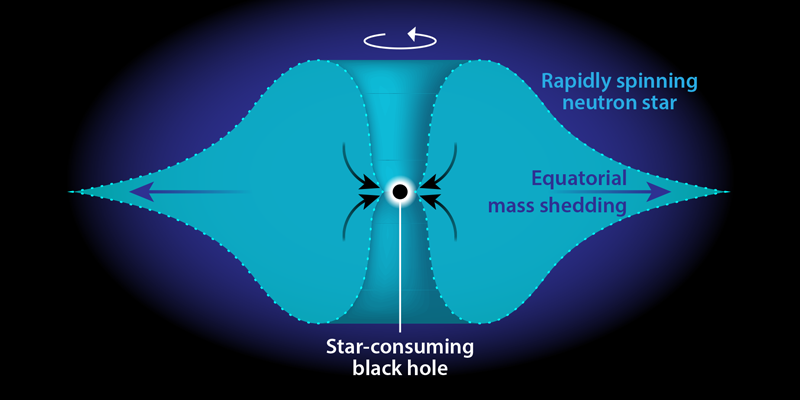
Fuller et al. propose a model for the synthesis of heavy elements in which a rapidly rotating neutron star is swallowed from the inside by a tiny black hole. The centrifugally deformed star, shown in cross-section, sheds considerable mass at its equator as it spins up and angular momentum is transferred outward. Heavy atomic nuclei, including gold and platinum, can form via the r-process in the neutron-rich matter that’s expelled from the imploding star. Credit: APS/Alan Stonebraker, via Physics
(Phys.org)—A team of researchers at the University of California has come up with a new theory to explain how heavy elements such as metals came to exist. The group explains their theory in a paper published in the journal Physical Review Letters—it involves the idea of primordial black holes (PBHs) infesting the centers of neutron stars and eating them from the inside out.
Space scientists are confident that they have found explanations for the origins of light and medium elements, but are still puzzling over how the heavier elements came to exist. Current theories suggest they most likely emerged during what researchers call an r-process—as in rapid. As part of the process, large numbers of neutrons would come under high densities, resulting in capture by atomic nuclei—clearly, an extreme environment. The most likely candidate for creating such an environment is a supernova, but there seem to be too few of them to account for the amounts of heavy elements that exist. In this new effort, the researchers offer a new idea. They believe it is possible that PBHs occasionally collide with neutron stars, and when that happens, the PBH becomes stuck in the center of the star. Once there, it begins pulling in material from the star's center.
PBHs are still just theory, of course. They are believed to have developed shortly after the Big Bang. They are also believed to roam through the galaxies and might be tied to dark matter. In this new theory, if a PBH happened to bump into a neutron star, it would take up residence in its center and commence pulling in neutrons and other material. That would cause the star to spin rapidly, which in turn would fling material from its outermost layer into space. The hurled material, the researchers suggest, would be subjected to an environment that would meet the requirements for an r-process, leading to the creation of heavy metals.
The theory assumes a certain number of such collisions could and did occur, and also that at least some small amount of dark matter is made up of black holes, as well. But it also offers a means for gathering real-world evidence that it is correct—by analyzing mysterious bursts of radio waves that could be neutron stars imploding after internal consumption by a PBH.
© 2017 Phys.org