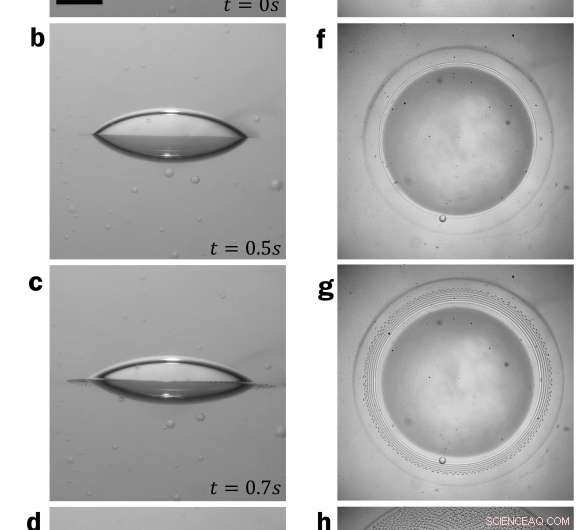
Development of the rim instability observed from direction perpendicular to the applied electric field (a-d), and along the applied electric field (e-h); the field direction is the axis of symmetry. Spherical drops (a,e) deform as the electric field (E = 4kV /cm) is turned on at t = 0. In equatorial-streaming the mother drop flattens to aspect ratio of about 0.5 and forms a sharp, cusp-like rim (b)-(f). The emission of rings occurs radially in the equatorial plane of the drop (g)-(h).Viscosity ratio is λ = 0.07. Scale bar is 500µm. Credit: arXiv:1612.08613 [cond-mat.soft]
(Phys.org)—A pair of researchers at Brown University has found that it is possible to induce a drop of fluid to emit smaller droplets in a way that resembles the planet Saturn with its rings. In their paper published in the journal Physical Review Letters, Quentin Brosseau and Petia Vlahovska describe the path they took to discovering the interesting droplet formations and possible uses for them.
Prior research has shown that exposing a drop of fluid that conducts electricity to an electric field causes electrically charged poles to form. If enough charge is applied, the drop will begin to adopt a cone shape. More charge will cause tiny droplets to become detached from the cone, resulting in a spray at the tip of the cone. In this new effort, the researchers were observing such electrosprays and what happens when a single drop of fluid is dropped into another fluid—in this case, the dropped fluid was less electrically conductive than its host. In their experiments, they dropped bits of silicone oil into a bowl of castor oil.
Prior research had also shown that modifying the charge applied to drops in other fluids could result in drop formations that resembled footballs. In the experiments by Brosseau and Vlahovska, as an electric field was applied, the drops began to flatten, eventually coming to look similar in shape to M&M candies. Making the field even stronger caused tiny droplets to be pulled from the drop, which formed into concentric rings around the drop's equator, looking eerily similar to the planet Saturn and its rings. The researchers report that the original droplets grew to become one millimeter wide, while the jettisoned droplets were approximately 100 times smaller.
One interesting aspect of the drops comprising the rings, the researchers found, was their uniformity of size—a feature that could be useful for making things like drugs. They also found that they were able to control the generation of the droplet rings by manipulating the charge field, another factor that could prove useful in a manufacturing process. The pair plan to continue their research into drop formations using different materials.
© 2017 Phys.org