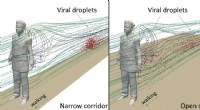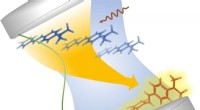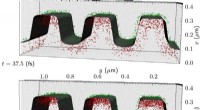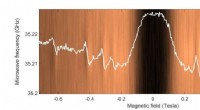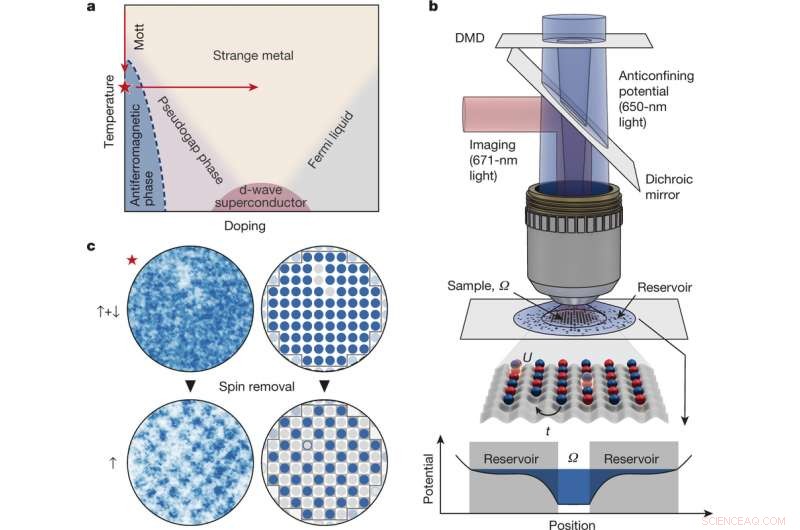
Probing antiferromagnetism in the Hubbard model with a quantum gas microscope. a, Schematic of the two-dimensional Hubbard phase diagram, including predicted phases. b, Experimental set-up. c, Exemplary raw (left) and processed (right) images of the atomic distribution of single experimental realizations, with both spin components present (upper; corresponding to the starred point in a) and with one spin component removed (lower). The observed chequerboard pattern in the spin-removed images indicates the presence of an antiferromagnet. Credit: (c) Nature (2017). DOI: 10.1038/nature22362
(Phys.org)—A team at Harvard University has found a way to create a cold-atom Fermi–Hubbard antiferromagnet, which offers new insight into how electrons behave in solids. In their paper published in the journal Nature, the group describes their experiments, a new tool they developed, and what they believe they have demonstrated using cold atoms in optical lattices in exploring the Fermi–Hubbard model. Thierry Giamarchi with the University of Geneva offers a News & Views piece on the work done by the team and offers background regarding the Fermi–Hubbard model, including an explanation of why simulating the model is so important.
As scientists continue to look for superconductivity at room temperatures, they advance the understanding of electron behavior in solids—specifically the ways quantum-mechanical interactions work regarding electronic properties. Calculating such interactions has proved to be beyond current capabilities, so scientists have developed models that can be calculated instead. One of these, the Fermi–Hubbard model, is based on Fermi-Dirac particles jumping between points on a lattice. Unfortunately, despite its simplicity, calculations for the model can only be made for one-dimensional lattice points.
To use the model to develop superconductors, 2-D calculations are required. Because of this limitation, some scientists have attempted to create a physical entity to simulate a Fermi–Hubbard model. In this new effort, the researchers have created just such a physical entity, and in doing so, have come closer to achieving the Fermi–Hubbard model than other attempts. They have done so by overcoming two major problems that stymied other teams: achieving low enough temperatures, and solving density representation problems.
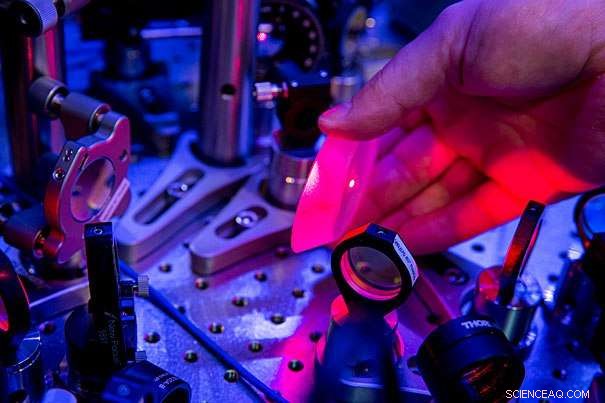
“The problem in trying to come up with better superconductors is that if you take a material and change one parameter … lots of things are changing,” Demler said. “With this simulation, we have full control of parameters. So we can actually understand what helps and what suppresses superconductivity.” Credit: Rose Lincoln/Harvard Staff Photographer
The researchers created a lattice using lasers and then trapped lithium-6 atoms in its wells. They then added a new feature to cool the system by surrounding the lattice with other atoms that served as a coolant. To overcome the density issues, they developed what they describe as a "fermionic microscope" to track points on the lattice. After filling the lattice with atoms, the group reports that the entire scheme behaved like an antiferromagnetic insulator. They suggest their creation could be used to study a wide variety of physics problems, and possibly to help in the search for a high-temperature superconductor.
© 2017 Phys.org