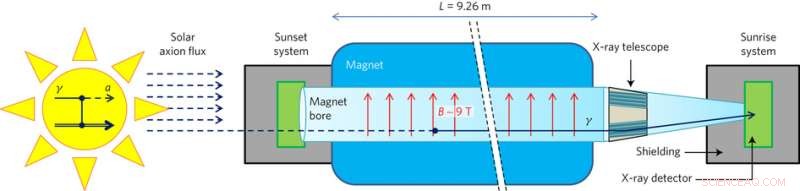
Sketch of the CAST helioscope at CERN to search for solar axions. Credit: Nature Physics (2017) doi:10.1038/nphys4109
(Phys.org)—A team of researchers working on the CERN Axion Solar Telescope (CAST) project report passing an important milestone in their search for the axion—they have moved below established astrophysical constraints and are now working in an area that is expected to reap many rewards regarding both the axion and other avenues of physics research. In their paper published in the journal Nature Physics, the team describes their work, what they have found, and what they believe is on the horizon. Maurizio Giannotti with Barry University offers a News & Views piece in the same journal issue covering the history of the axion, the work done by the CAST team, and where future research in the area is likely headed.
The axion is a theorized particle that was introduced to explain why there is a difference in symmetry between the strong forces in respect to time. Since its introduction, it has been added to the mix of theory regarding dark matter. The only problem is that no one has been able to find one—but that is not for lack of trying. Multiple experiments have been conducted with the purpose of proving that axions really do exist. But until now, all such experiments have been constrained by equipment unable to probe the area below values of established astrophysical constraints. In this new effort, the researchers probed that area for the first time, and though they have not been able to spot an axion, they report that the potential now exists due to the advanced hardware at their disposal.
If axions exist, theory suggests that they should be made visible by a very strong magnet—it should convert them to X-rays that could be seen and measured with standard technology. To that end, the group at CAST has placed a giant magnet (a castoff from the main CERN project) and placed it on a track to allow it to track directly with the sun. Theory also suggest that axions should be produced by virtually all stars, including ours. Using this new technology, the researchers have been looking for X-rays that have no known source (identifiable by a certain energy level), which would leave axions as the likely suspect. And even if they do not find any, they report that they are confident that they will find new phenomena that will enhance the field.
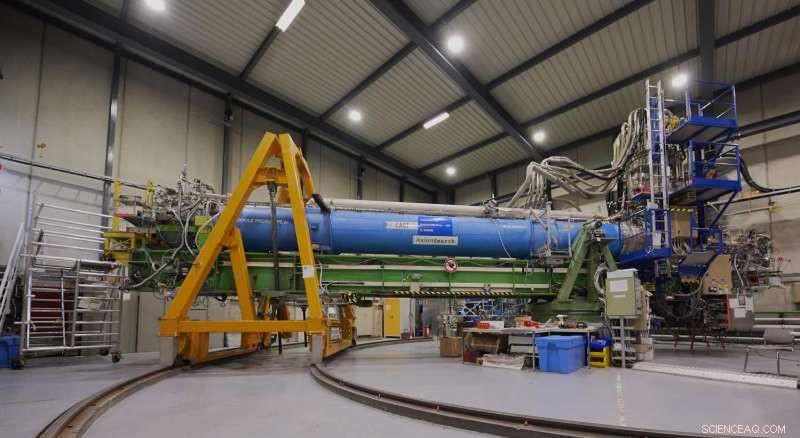
The strong magnet can be found in the blue pipe of the CERN Axion Solar Telescope (CAST) with which researchers seek to capture axions from the sun. Credit: Photo: CERN
© 2017 Phys.org