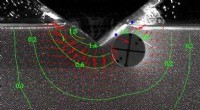
* Wave nature: Sound waves are longitudinal waves, meaning they oscillate parallel to their direction of travel. Light waves are transverse waves, oscillating perpendicular to their direction of travel.
* Refraction: Refraction (the bending of waves) is the principle behind lenses. It occurs when waves transition from one medium to another, causing a change in speed. While sound waves can refract, the effect is much less pronounced than with light waves. This is because sound travels at a much slower speed and is less affected by changes in medium density.
* Diffraction: Sound waves diffract (spread out) much more easily than light waves. This makes it difficult to focus sound waves using a lens-like structure.
Instead of lenses, sound focusing is typically achieved through:
* Parabolic Reflectors: A concave parabolic shape can reflect sound waves towards a focal point, effectively concentrating the sound energy. This is the principle used in satellite dishes and hearing aids.
* Acoustic Lenses: These are complex structures made from different materials that manipulate sound waves through interference and diffraction. They can be used to focus sound, but they are more sophisticated and less common than parabolic reflectors.
The key takeaway: The physics of sound waves makes traditional lens-like focusing methods impractical. Instead, we use different approaches like reflectors and more complex acoustic devices.