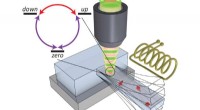
Here's how it works:
* Electron Beam: Instead of light, a TEM uses a beam of electrons.
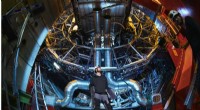
* Magnetic Lenses: The beam is focused and steered using electromagnetic lenses. These lenses act like optical lenses but use magnetic fields to manipulate the electron beam.
* Thin Sample: The sample being viewed must be extremely thin (often only a few hundred nanometers thick) so the electrons can pass through it.
* Image Formation: When the electrons pass through the sample, some are scattered, while others pass through unaffected. The scattered and unscattered electrons are then projected onto a screen or detector, creating an image.
Key Features of TEM:
* High Resolution: TEMs can achieve extremely high resolution, allowing scientists to view objects at the atomic level.
* Thin Samples: The requirement for thin samples limits the types of materials that can be studied.
* Complex Preparation: Preparing samples for TEM can be a complex and time-consuming process.
The use of magnetic fields in TEM allows for precise control of the electron beam, making it an incredibly powerful tool for scientific research in fields like biology, materials science, and nanotechnology.