What is a Wavefront?
* A wavefront represents the locus of points that are in phase, meaning they have the same displacement and are at the same point in their oscillation cycle.
* For example, imagine dropping a pebble into a still pond. The wavefronts are the concentric circles that expand outwards from the point of impact.
How Shape Changes Affect Wave Behavior:
1. Direction of Propagation:
* A planar wavefront (flat) indicates the wave travels in a straight line.
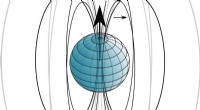
* A spherical wavefront (curved) indicates the wave travels outwards radially from a point source.
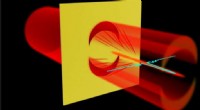
* A cylindrical wavefront indicates the wave travels outwards along a line.
* Changes in wavefront shape can therefore alter the direction of wave propagation.
2. Intensity:
* The curvature of a wavefront influences its intensity.
* As a wavefront expands, it becomes less curved. This leads to a decrease in intensity (energy per unit area) as the energy is spread over a larger area.
3. Diffraction:
* Diffraction is the spreading of waves as they pass through an opening or around an obstacle.
* The shape of the wavefront influences the degree of diffraction.
* A wavefront with a smaller radius of curvature will diffract more than a wavefront with a larger radius of curvature.
4. Focusing:
* Lenses and mirrors are designed to alter the shape of wavefronts.
* A concave lens or mirror can converge a spherical wavefront to a point, focusing the wave.
* A convex lens or mirror can diverge a spherical wavefront, spreading the wave out.
Examples:
* Refraction: When light passes from one medium to another (e.g., air to water), its speed changes. This change in speed can alter the shape of the wavefront, causing the light to bend or refract.
* Reflection: When light bounces off a surface, the angle of reflection depends on the shape of the reflecting surface. A curved surface can cause the wavefront to converge or diverge.
In summary, the shape of a wavefront is a crucial factor determining its behavior and how it interacts with its surroundings. Changes in wavefront shape directly impact direction of propagation, intensity, diffraction, and focusing.