Here's a breakdown of what happens:
* Light as waves: Light behaves as both a wave and a particle. When light interacts with matter, it's easier to think of it as a wave.
* Interaction with particles: When a light wave encounters a particle of matter, the wave interacts with the electrons in that particle.
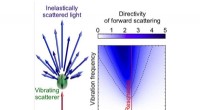
* Absorption and re-emission: The light wave is temporarily absorbed by the particle, causing the electrons to vibrate. Then, the electrons re-emit the light wave, but in a different direction.
* Scattering: The re-emitted light wave travels in a different direction than the original wave. This change in direction is called scattering.
Types of Scattering:
* Rayleigh Scattering: Scattering of light by particles much smaller than the wavelength of light. This is why the sky appears blue, as shorter wavelengths (blue) scatter more than longer wavelengths (red).
* Mie Scattering: Scattering of light by particles that are roughly the same size as the wavelength of light. This is responsible for the white color of clouds.
* Non-selective Scattering: Scattering of light by particles much larger than the wavelength of light. This type of scattering affects all wavelengths equally, resulting in a white or grayish appearance.
Applications of Scattering:
* Optical fibers: Light travels through optical fibers by repeated reflection and scattering.
* Meteorology: Studying the scattering of light by water droplets and ice crystals in the atmosphere helps us understand weather patterns.
* Astronomy: Scattering of light by interstellar dust helps astronomers study the composition and structure of distant galaxies.
Let me know if you'd like to delve deeper into any specific type of scattering!