1. Speed of Light:
* Light travels at different speeds in different mediums. It travels faster in a vacuum (like space) than it does in denser mediums like glass.
2. Change in Direction:
* When light enters a denser medium (like glass) from a less dense medium (like air), it slows down. This change in speed causes the light to change direction.
* The light ray bends towards the normal (an imaginary line perpendicular to the surface of the glass) because the part of the wave that enters the glass first slows down before the rest of the wave.
3. Snell's Law:
* The amount of bending is determined by the angle of incidence (the angle at which the light hits the surface) and the refractive index of the two mediums.
* Refractive index is a measure of how much a medium slows down light. A higher refractive index means a greater change in direction.
* Snell's Law describes this mathematically: n₁ sin θ₁ = n₂ sin θ₂
* n₁ and n₂ are the refractive indices of the two mediums
* θ₁ and θ₂ are the angles of incidence and refraction, respectively.
In simpler terms:
Imagine a car driving on a road. If the car enters a muddy field, it slows down. The front wheels enter the mud first, slowing down before the back wheels. This causes the car to turn towards the direction of the mud.
Similarly, when light enters glass, one part of the wave slows down first, causing the entire wave to bend.
Examples of Refraction:
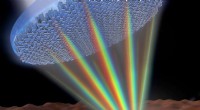
* Rainbow: Light bends when it passes through water droplets in the air, separating the different colors.
* Magnifying glass: Light bends as it passes through the curved lens, magnifying the image.
* Optical fibers: Light bends repeatedly within the fiber, allowing it to travel long distances.
Let me know if you'd like more details about any of these concepts!