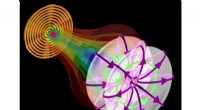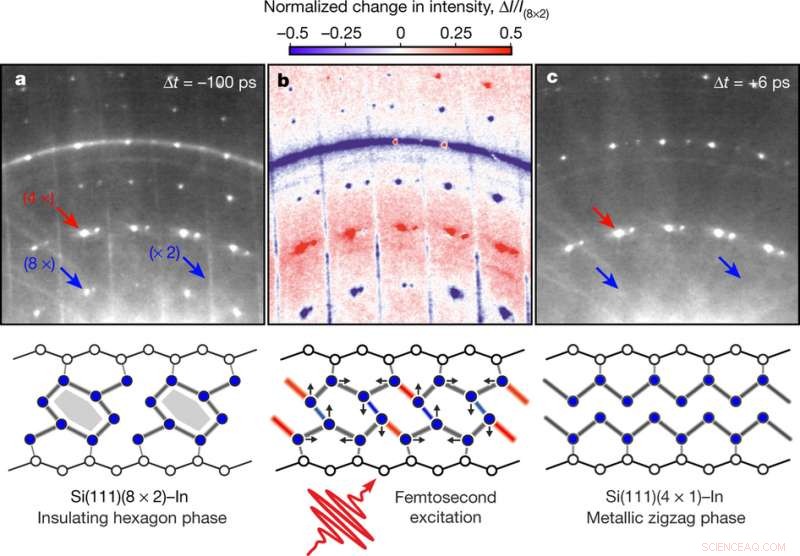
Electron diffraction patterns and surface structures. Credit: (c) Nature (2017). DOI: 10.1038/nature21432
(Phys.org)—A team of researchers from several institutions in Germany has used laser pulses to change an atomic wire from an insulator to a metal and back again in what the group describes as the fastest electronic switch ever observed. In their paper published in the journal Nature, the team describes their experiments testing the boundaries of phase transition speeds, which have proven that it can occur much faster under certain conditions than was thought possible.
Phase transition speed, as the researchers note, is typically constrained by the speed at which energy can enter a system. Ice turning to water, for example, is constrained by the speed at which heat can enter the ice. The process follows the rules of quantum mechanics, of course, though few theorists have believed it was possible for a transition to occur as fast as the rules allowed. In this new effort, the researchers have shown that such is the case by causing such a transition to occur.
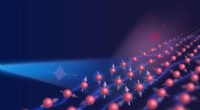
To test the limits of transition speed, the researchers cooled samples of indium on silicon to 30K and then measured the electron diffraction pattern of the surface and found it to be an insulator. They then fired a laser at the sample causing it to heat up very quickly—indium atoms assemble themselves automatically into three atom wide metallic wire when heated. Then they fired another laser pulse to measure how the diffraction pattern had changed. They repeated the process multiple times varying the time between laser firings to see how much time transpired before the insulator became a metal—as it turned out, for times longer than 350 fs. They also tried varying the amount of laser power and found that the more power they applied, the faster the transition—up to a point where it became a constant, which the team noted, was the quantum limit.
Though describing the transition event as the fastest electronic switch ever observed, the team readily acknowledges that they are not suggesting that it could be used to somehow create optical switches for use in practical applications. Rather, they note, it was just some theorists doing some basic research.
© 2017 Phys.org