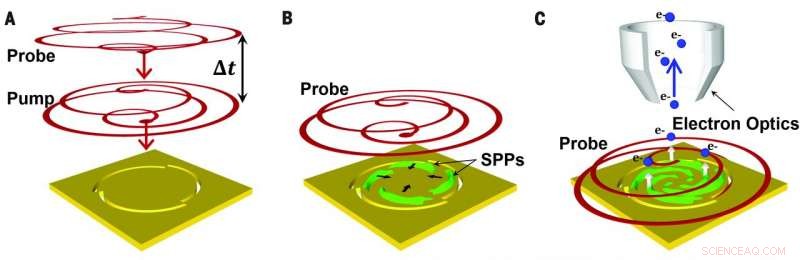
Schematic experimental methodology. Credit: (c) Science (2017). DOI: 10.1126/science.aaj1699
(Phys.org)—A team of researchers with members from institutions in Germany and Israel has developed a way to launch plasmons with controlled amounts of angular momentum using spiral-like structures fashioned into a smooth layer of gold plate. In their paper published in the journal Science, the group describes their technique and why they believe it could one day provide the basis for a new type of storage device.
Prior work had shown that it was possible to use orbital angular momentum of photons as a way to store data in the air (because of their different phase advances—each could be used to represent an individual character), which in practical use would be optical fibers. In this new effort, the researchers have found a way to do much the same thing, only on a chip, which allows for it to be confined, making it much easier to port to an actual application.
To accomplish this feat, the researchers turned to plasmonics, which are oscillations in quantum particles or quasiparticles. In this case, it was the oscillation of electrons that occurs when photons strike a metal surface. The idea, the researchers noted, was that plasmons allow for confining light, which meant that it was possible to make its wavelength conform to a metal surface. They found they were able to kick off plasmon waves with angular momentum by etching spirals into a gold plate—that allowed for monitoring its motion using an electron microscope.
Using it, they were able to see that firing photons at the spiral in the plates caused electrons to be ejected, which was an indirect way to "see" plasmons, which were controlled by the angular momentum of photons. This meant it was possible to use the initial wave advances to represent characters within the confines of a computer chip. That day is still a long way off, of course— the work was more a proof of concept than a finished product. But if a way can be found to mass produce chips using the technique, end users could see a huge increase in the amount of data storage. The work also suggests, the team notes, that it might be possible to do some things with light that have never been possible before.
© 2017 Phys.org