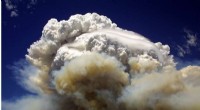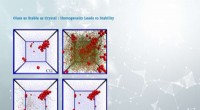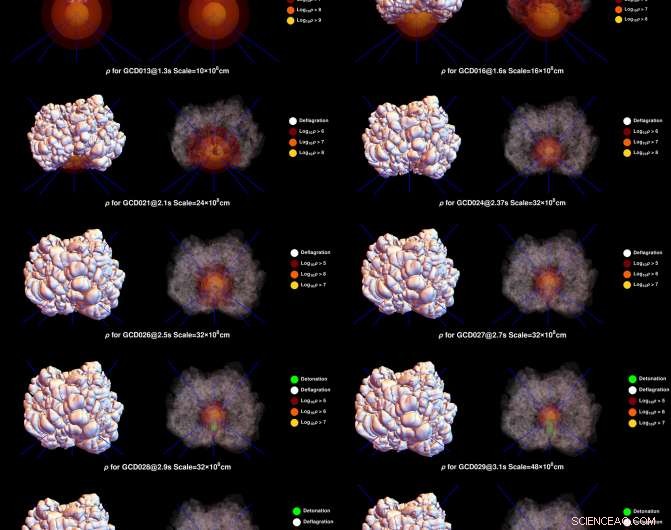
Density contour plots including deflagration (white) and detonation (green) surfaces. Credit: arXiv:1609.07403 [astro-ph.HE]
(Phys.org)—A team of researchers at North Carolina State University has found that current and future neutrino detectors placed around the world should be capable of detecting neutrinos emitted from a relatively close supernova. They also suggest that measuring such neutrinos would allow them to explain what goes on inside of a star during such an explosion—if the measurements match one of two models that the team has built to describe the inner workings of a supernova.
Supernovae have been classified into different types depending on what causes them to occur—one type, called a la supernova, occurs when a white dwarf pulls in enough material from a companion, eventually triggering carbon fusion, which leads to a massive explosion. Researchers here on Earth can see evidence of a supernova by the light that is emitted. But astrophysicists would really like to know more about the companion and the actual process that occurs inside the white dwarf leading up to the explosion—and they believe that might be possible by studying the neutrinos that are emitted.
In this new effort, a team led by Warren Wright calculated that neutrinos from a relatively nearby supernova should be detectable by current sensors already installed and working around the planet and by those that are in the works. Wright also headed two teams that have each written a paper describing one of two types of models that the team has built to describe the process that occurs in the white dwarf leading up to the explosion—both teams have published their work in the journal Physical Review Letters.
The first model is called the deflagration-to-detonation transition; the second, the gravitationally confined detonation. Both are based on theory regarding interactions inside of the star and differ mostly in how spherically symmetric they are. The two types would also emit different kinds and amounts of neutrinos, which is why the team is hoping that the detectors capable of measuring them will begin to do so. That would allow the teams to compare their models against real measurable data, and in so doing, perhaps finally offer some real evidence of what occurs when stars explode.
© 2017 Phys.org