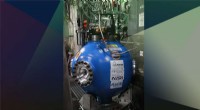
The PICO bubble chambers use temperature and sound to tune into dark matter particles. Credit: SNOLAB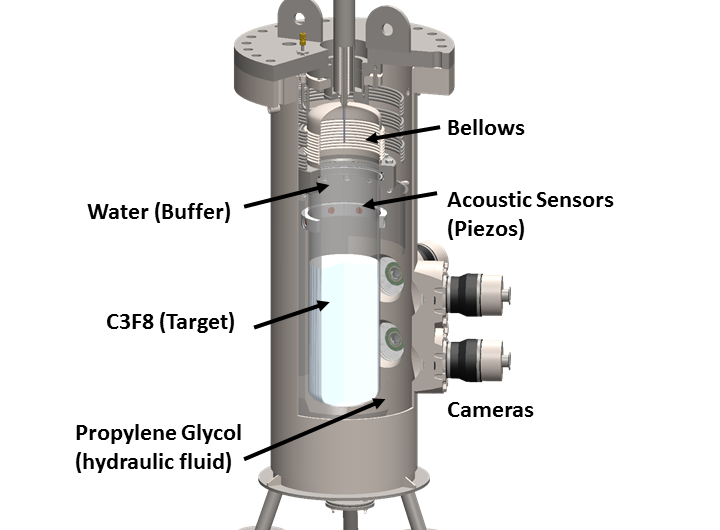
"This sensitivity means we can build a larger detector and run it longer with the expectation that there will not be background from other types of radiation," said David Asner, Chief Scientist for particle physics at Department of Energy's Pacific Northwest National Laboratory and a member of the PICO Collaboration.
Because physicists can't "see" dark matter, they need to find something that will alert them if dark matter bumps into it, sort of how a motion-sensitive alarm screeches when moved. Bubble chambers do this. Filled with a liquid kept just below its boiling temperature, bubbles erupt when a tiny particle with just enough energy hits the chamber. And physicists know little about dark matter, so they are searching for a variety of possible forms. Members of the PICO science team are looking for a particular type called spin-dependent WIMPs. The highly sensitive bubble chamber is filled with a fluorine-containing liquid that responds by forming a bubble when a neutron from certain types of radiation plows through. They theorize that if—or when—one of these WIMPs does so, the bubble chamber will also detect this dark matter particle.
"We don't know the nature of dark matter interactions with regular matter. PICO provides a unique probe and opportunity for discovery," said Asner.