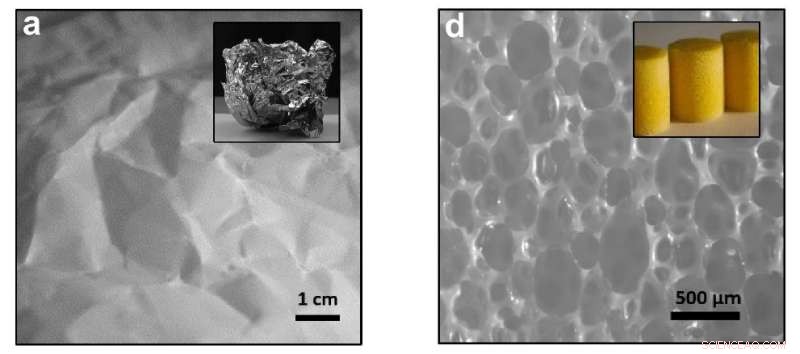
(a) A network of creases decorating the face of an unfolded crumpled ball of Mylar. Inset: a crumpled Mylar ball. (b) Stress relaxation of the crumpled Mylar ball. Credit: arXiv:1608.02429 [cond-mat.soft]
(Phys.org)—A small team of researchers at Harvard University has found that crumpled sheets of Mylar hold a memory of how long they were crumpled. In their paper published in the journal Physical Review Letters, the group describes experiments they conducted in their lab with Mylar and tubes affixed with pressure measuring devices and what they learned about the disordered mechanical system.
Physicists have been grappling with disordered mechanical systems for quite some time, and compared to other areas of study, have made little progress toward understanding them. One example is the way that glass responds when it is heated and then allowed to cool—it behaves like a flowing viscous liquid, and nobody has been able to explain why. Another example is the way grain (or sand) settles in a pile. In this new effort, the researchers studied sheets of crumpled Mylar—previous studies have shown that the thin metal (often used in gum or candy wrappers), when crumpled and held down by a weight, inexplicably loses volume logarithmically over several weeks.
This time around, the team crumpled sheets of Mylar randomly and individually stuffed them into plastic tubes and then placed a weight atop each. After a set amount of time, they pulled the weight back a bit to ease pressure on the Mylar and then timed how long it took for the crumpled sheet to stop exerting an upward force against the weight. After repeating the same experiment for different lengths of time, the researchers were surprised to find that the time it took for the crumpled sheet to stop pushing back was proportional to the amount of time that it had been smashed down—the sheet somehow "remembered" how long it had been smooshed. The researchers freely admit they have no idea how a Mylar sheet can retain such a memory.
Such experiments demonstrate not only the difficulty in understanding disordered mechanical systems but adds to a growing body of evidence that suggests such systems might have more in common with disordered molecular systems than has been thought. This experiment in particular also adds another member to the list of materials that somehow "know" or "remember" things, but defy explanation as to how they do it.
© 2017 Phys.org