Here's the short answer: There's nothing "between" particles in the traditional sense of empty space.
Here's why:
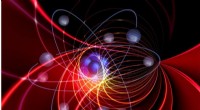
* Quantum Mechanics: At the atomic and subatomic level, the rules of classical physics don't quite apply. Quantum mechanics describes particles not as tiny billiard balls, but as fuzzy clouds of probability. These clouds can overlap and interact, even though they don't occupy the same space in the classical sense.
* Fields: Instead of empty space, physicists talk about fields. These fields permeate all of space and carry forces like gravity, electromagnetism, and the strong and weak nuclear forces. Particles interact with each other through these fields.
* Virtual Particles: Even in what we might think of as "empty" space, there are constant fluctuations in these fields, giving rise to virtual particles that pop in and out of existence for brief moments.
Think of it this way: If you zoom in close enough, you'll see that the "empty" space between particles is actually filled with a dynamic and constantly changing sea of energy and interactions.
Here are a few more details:
* The Higgs Field: This field is believed to give particles their mass.
* Vacuum Energy: Even in the "empty" space of the vacuum, there's still a non-zero energy level due to these quantum fluctuations.
It's important to remember that this is a very simplified explanation. The true nature of the universe at the quantum level is still being explored and understood by physicists.