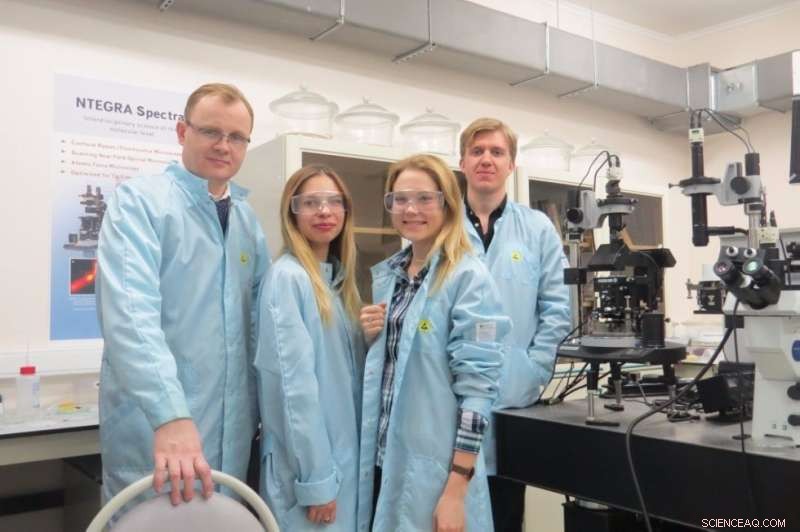
Credit: Kazan Federal University
According to current estimates, dozens of zettabytes of information will be stored electronically by 2020, which will rely on physical principles that facilitate the use of single atoms or molecules as basic memory cells. This can be done using lasers. However, existing methods of optical storage are limited to the diffraction limit (~500 nm), so the respective recording density is roughly ~1 Gb per square decimeter.
The limitation can be circumvented by the use of highly localized lasers that can manipulate the spatial orientation of single molecules. The expected storage capacity in this case is up to 1 Pb/dm2, which is approximately equal to 1 million standard DVDs. Regulating radiation beyond the diffraction limit with the help of optical nanoantennas and nanoresonators is the basis for three current research areas—refractory plasmonics, organic photovoltaics, and near-field optical memory. All of them are in development at the Nano Optics Lab of KFU headed by Associate Professor Sergey Kharintsev.
Thanks to subdiffraction localization and field enhancement of light, single-molecule detection technologies are emerging rapidly. Dr. Kharintsev's team has used this approach for near-field optical recording. Their research appeared in Nanoscale in November 2016. The authors proposed a new principle of optical storage based on tip-enhanced Raman scattering effect.
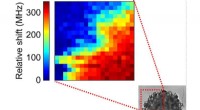
Localization of laser light is provided by an optical nanoantenna that is illuminated by a focused laser beam with radial and azimuthal polarization. This approach is based on optical anisotropy of azo-dye polymer films, as reported in ACS Photonics. The azo-dyes are orientated perpendicularly to the polarization direction under polarized light. This has proven to be a tricky achievement because near-field polarization depends on the geometry and material of the optical antenna.
Switching between radial and azimuthal polarization enables the recording of optical information in the azo-dye absorption band and reading beyond that band. The switching speed depends on the local mobility of the dyes in a glassy environment—a parameter critically dependent on the thickness of polymer film. The team plans to create a prototype of organic near-field optical memory of up 1 Pb/dm2 density. Advances in subdiffraction technology will be linked to laser beams with orbital momentum—such research may eventually increase storage density.
Optical disks with petabit capacity will change the efficiency and productivity of cloud services and data centers and disrupt the global storage market. The development of such storage is linked with energy-independent, high-speed memory technologies that aim to unite the advantages of random access memory and archive memory. Alternative memory types, such as quantum memory, spin-transfer torque memory, memristors, and ferroelectrical memory, are all still far from practical use.