Here's a breakdown of the key findings and what they implied:
* Most alpha particles passed straight through the foil: This indicated that atoms are mostly empty space.
* Some alpha particles were deflected at large angles: This showed that there was a concentrated, positively charged region within the atom, as alpha particles (positively charged) were repelled by it.
* A few alpha particles bounced back directly: This was the most surprising result, and it suggested that this positively charged region was extremely dense and small, like a tiny, hard core.
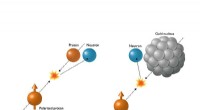
Rutherford's experiment led him to propose the nuclear model of the atom, where:
* A tiny, dense nucleus containing protons and neutrons resides at the center of the atom.
* Electrons orbit the nucleus in a vast, mostly empty space.
This model revolutionized our understanding of atomic structure and paved the way for further discoveries in atomic physics.