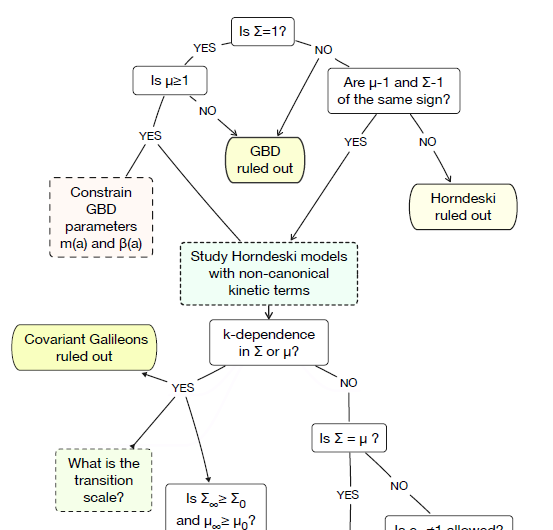
In a flowchart, Alessandra Silvestri and Levon Pogosian answer questions with ‘yes’ and ‘no’, leading to the subsequent conclusion. For example, if μ is greater than one and Σ is less, then a large collection of models is ruled out; the so-called Horndeski class. Credit: Leiden Institute of Physics
Cosmologists have many possible models for the universe, of which only one can be true. A new flowchart detailed in Physical Review D on November 7 will eliminate some of them when two specific universe features are accurately measured.
Cosmologists try to understand how the entire universe formed and evolves. In short, cosmology is the science of everything above the scale of our pale blue dot floating around in the vastness of space. By aiming their telescopes at distant galaxies and the afterglow of the Big Bang, cosmologists look back in time and pick up pieces of the puzzle. They used these pieces as parameters in the many possible models they have created for the universe. The more precisely parameters are measured, the more models can be excluded.
Perturbations
Lately, astrophysicists have done many observations to measure two specific parameters. These are called μ and Σ. They represent how fast galaxies formed from the irregularities in the universe just after the Big Bang and how much distant light is bent by gravitational lensing. Recently measured values of μ and Σ generally show a mild tension with the leading cosmological model called ΛCDM. More and better observations will characterize an accurate value of the two parameters. Things would get very interesting if the observed μ and Σ indeed did not agree with the values expected in the popular ΛCDM model. So then what?
Flowchart
Leiden University physicist Alessandra Silvestri and Levon Pogosian from Simon Fraser University published a paper in Physical Review D with an overview of all the models ruled out by each value measured. In a flowchart, they answered questions with 'yes' and 'no,' leading to the subsequent conclusion. For example, if μ is greater than one and Σ is less, then a large collection of models is ruled out; the so-called Horndeski class. With their paper, they add more significance to future cosmological observations, as it lends concrete meaning to the measurement of otherwise abstract values.