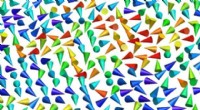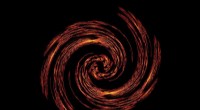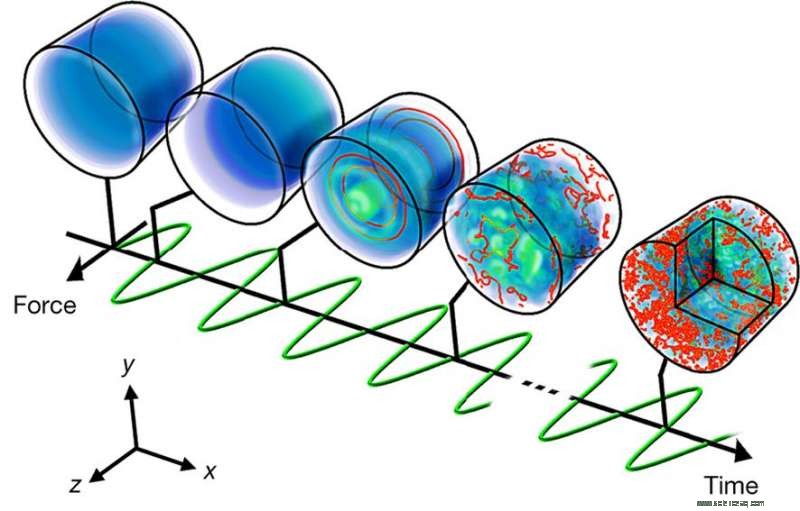
Gross–Pitaevskii simulations of a shaken, box-trapped Bose gas. The blue shading indicates the gas density; the red lines indicate vortices. Credit: (c) Nature (2016). DOI: 10.1038/nature20114
(Phys.org)—A team of researchers at the University of Cambridge has succeeded in creating turbulence in a Bose–Einstein condensate (BEC) and in the process, have possibly opened the door to a new avenue of research. In their paper published in the journal Nature, the team describes how they achieved this feat and the evidence they found for a cascade. Brian Anderson with the University of Arizona offers a News & Views piece describing the work done by the team in the same journal issue and offers a brief overview of the characteristic distribution of kinetic energy in turbulent fluids.
Scientists have learned a lot about the nature of turbulence in fluids over the past several hundred years, some of which surrounds the way kinetic energy is distributed among components that have different momenta—which can be seen in action, as Anderson notes, by stirring cream into a cup of coffee. But until now, no one had succeeded in producing turbulence in a BEC, in which a gas of bosons is cooled to near absolute zero causing them to occupy the lowest possible quantum state, thereby allowing for viewing quantum phenomena—Anderson calls them "microscopic droplets of atomic gasses."
In this new effort, the researchers conducted experiments designed to discover what might happen if turbulence were introduced to a BEC, in this case, one made of rubidium atoms captured in a laser-created virtual box—this type of setup provided uniform density of the atoms. The team then applied a timed magnetic field that served to shake up the cloud of atoms, which added energy to the system. They then determined the momentum distribution. For small time intervals, they found most of the atoms in the cloud were in a low-momentum mode—more shaking pushed the atoms into a higher momentum mode. After approximately two seconds, the researchers found evidence of a cascade of excitations by releasing the cloud and capturing what occurred with a 2-D camera.
The method used by the team to cause the turbulence in a BEC is likely to be used as a model for future experiments involving quantum turbulence.