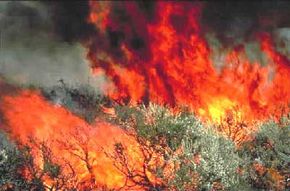
The wildfire that killed five firefighters and burned more than 40,000 acres in Esperanza, Calif., in October 2006 was determined almost immediately to have been the result of arson. While investigators were careful not to release the details that led them to this decision so quickly, there are certain techniques that investigators use when trying to find the cause of a fire. Investigating a wildfire is usually harder than investigating a building fire, because there are so many more environmental factors involved when the blaze is out in the open. But the primary techniques are the same. It all starts with finding the point of origin.
Wildfires have very specific ways of behaving. Even with the unpredictability of nature and the seemingly out-of-control behavior of a fire burning through acres and acres of forest, there are characteristics you can count on. For one thing, wildfires start small and then get hotter, bigger and higher as they burn. They spread outward, usually in a V-shaped or U-shaped pattern. They move faster uphill, and they tend to move with the direction of wind. With these traits in mind (and many others -- see How Wildfires Work to learn more), investigators look for clues that point to the fire's source.
The search for patterns starts at the very widest part of the V or U shape, the outside of the fire's burn path. Investigators work backward from the outer lines, examining everything in the fire's path for clues to the direction in which the fire was moving. If they can find out which way the fire was moving, and they combine that with the layout of the land and the wind directions for the fire's burn time, they can find out where the fire began. Some of the evidence investigators are analyzing as they make their way in from the edges of the burn include:
Investigators follow the clues -- burn patterns -- to find the general origin of the fire. Using classic crime-scene investigation techniques like line-walking, in which investigators form a tight line and walk in patterns over the crime scene looking meticulously for clues from the ground up, evidence will eventually narrow down the point of origin. What investigators ultimately want to work with is a point of origin that is about 10 feet by 10 feet (3 by 3 meters). The smaller the area, the better. At this point, investigators are getting down on their knees and sifting through dirt, ash, brush and everything else they can find that could possible house a match, a bottle of accelerant, a lighter, a footprint or a tire mark. Within this 100 square-foot (10-square-meter) area is where the cause of the fire will most likely be found.
But even when something like a match or lighter turns up, it's difficult to figure out from the physical evidence alone whether a fire started by a human was accidental or an act of arson. And sometimes, all physical evidence of the fire's cause has been burned away. So what comes next is detective work: interviewing witnesses and first responders; finding out if any low-flying planes happened to catch sight of the blaze; collecting satellite imagery; and ruling out all viable natural causes. The NOAA should be able to tell detectives if there was lightning activity in the area; the power company will be able to report if there was a power line down; and the Parks department should be able to report if there were any legal burns going on in the vicinity that may have thrown a spark.
In the case of the deadly Esperanza fire, it is believed that witnesses reported at least one man fleeing the scene just moments before the blaze began. Police have arrested a man who is also suspected of starting seven other fires in the last year.
For more information on wildfires, arson and crime scene investigation, check out the links on the next page.