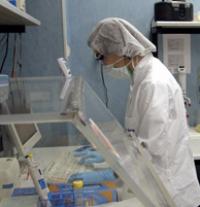
When there is a murder, suspicious fire or hit-and-run accident, police and rescue workers aren't the only ones in on the investigation. Forensic scientists also play an important part. They will take samples collected at the scene and analyze them in a forensics laboratory. With a little ingenuity and some very high-tech equipment, forensic scientists can help law enforcement catch even the wiliest perpetrator.
Forensic science is a discipline that applies scientific analysis to the justice system, often to help prove the events of a crime. Forensic scientists analyze and interpret evidence found at the crime scene. That evidence can include blood, saliva, fibers, tire tracks, drugs, alcohol, paint chips and firearm residue.
Up Next
Using scientific equipment, forensic scientists identify the components of the samples and match them up. For example, they may determine that a paint chip found on a hit-and-run accident victim came off a '96 Ford Mustang convertible, a fiber found at a murder scene belonged to an Armani jacket or a bullet was fired from a Glock G24 pistol.
How do forensic scientists turn even the tiniest clues into real evidence that can help track down criminals? What are the latest technologies being used today in forensics labs? Find out next.
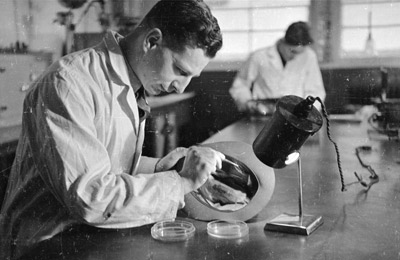
The history of forensic science dates back thousands of years. Fingerprinting was one of its first applications. The ancient Chinese used fingerprints to identify business documents. In 1892, a eugenicist (an adherent of the often prejudiced system of scientific classification) named Sir Francis Galton established the first system for classifying fingerprints. Sir Edward Henry, commissioner of the Metropolitan Police of London, developed his own system in 1896 based on the direction, flow, pattern and other characteristics in fingerprints. The Henry Classification System became the standard for criminal fingerprinting techniques worldwide.
In 1835, Scotland Yard's Henry Goddard became the first person to use physical analysis to connect a bullet to the murder weapon. Bullet examination became more precise in the 1920s, when American physician Calvin Goddard created the comparison microscope to help determine which bullets came from which shell casings. And in the 1970s, a team of scientists at the Aerospace Corporation in California developed a method for detecting gunshot residue using scanning electron microscopes.
Forensic Lab Safety
The job of a forensic scientist involves using a variety of
chemicals, which can be flammable, corrosive and even explosive if not
handled properly. Here are a few tips that forensic labs follow to
ensure that their employees stay safe:
In 1836, a Scottish chemist named James Marsh developed a chemical test to detect arsenic, which was used during a murder trial. Nearly a century later, in 1930, scientist Karl Landsteiner won the Nobel Prize for classifying human blood into its various groups. His work paved the way for the future use of blood in criminal investigations. Other tests were developed in the mid-1900s to analyze saliva, semen and other body fluids as well as to make blood tests more precise.
With all of the new forensics techniques emerging in the early 20th century, law enforcement discovered that it needed a specialized team to analyze evidence found at crime scenes. To that end, Edmond Locard, a professor at the University of Lyons, set up the first police crime laboratory in France in 1910. For his pioneering work in forensic criminology, Locard became known as "the Sherlock Holmes of France."
August Vollmer, chief of the Los Angeles Police, established the first American police crime laboratory in 1924. When the Federal Bureau of Investigation (FBI) was first founded in 1908, it didn't have its own forensic crime laboratory -- that wasn't set up until 1932.
By the close of the 20th century, forensic scientists had a wealth of high-tech tools at their disposal for analyzing evidence from polymerase chain reaction (PCR) for DNA analysis, to digital fingerprinting techniques with computer search capabilities.
Next, we'll see some of the applications of these modern forensic technologies.
Forensic labs are often called in to identify unknown powders, liquids and pills that may be illicit drugs. There are basically two categories of forensic tests used to analyze drugs and other unknown substances: Presumptive tests (such as color tests) give only an indication of which type of substance is present -- but they can't specifically identify the substance. Confirmatory tests (such as gas chromatography/mass spectrometry) are more specific and can determine the precise identity of the substance.
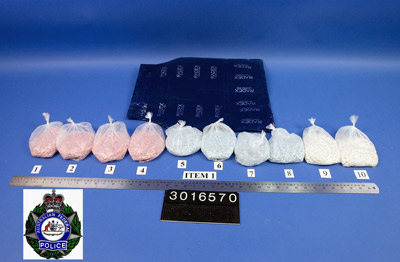
Color tests expose an unknown drug to a chemical or mixture of chemicals. What color the test substance turns can help determine the type of drug that's present. Here are a few examples of color tests:
Type of Test
ChemicalsWhat the Results Mean
Marquis Color
Formaldehyde and concentrated sulfuric acid
Heroin, morphine and most opium-based drugs will turn the solution purple. Amphetamines will turn it orange-brown.
Cobalt thiocyanate
Cobalt thiocyanate, distilled water, glycerin, hydrochloric acid, chloroform
Cocaine will turn the liquid blue.
Dillie-KoppanyiCobalt acetate and isopropylamine
Barbiturates will turn the solution violet-blue.
VanUrk
P-dimethylaminobenzaldehyde, hydrochloric acid, ethyl alcohol
LSD will turn the solution blue-purple.
Duquenois-Levine Test
Vanillin, acetaldehyde, ethyl alcohol, chloroform
Marijuana will turn the solution purple.
Other drug tests include ultraviolet spectrophotometry, which analyzes the way the substance reacts to ultraviolet (UV) and infrared (IR) light. A spectrophotometry machine emits UV and IR rays, and then measures how the sample reflects or absorbs these rays to give a general idea of what type of substance is present.
A more specific way to test drugs is with the microcrystalline test in which the scientist adds a drop of the suspected substance to a chemical on a slide. The mixture will begin to form crystals. Each type of drug has an individual crystal pattern when seen under a polarized light microscope.
Gas chromatography/mass spectrometry isolates the drug from any mixing agents or other substances that might be combined with it. A small amount of the substance is injected into the gas chromatograph. Different molecules move through the chromatograph's column at different speeds based on their density. For example, heavier compounds move more slowly, while lighter compounds move more quickly. Then the sample is funneled into a mass spectrometer, where an electron beam hits it and causes it to break apart. How the substance breaks apart can help the technicians tell what type of substance it is.
What methods do technicians use to help track down hit-and-run vehicles or arsonists? Find out next.Forensic scientists are sometimes called to help analyze evidence left from a hit-and-run or possible case of arson. They have special techniques to study what's often small or extremely damaged evidence.
Paint Analysis
Sometimes forensic scientists need to analyze a paint sample -- for example, if a paint chip is found on the body of a hit-and-run victim and investigators are trying to match it to a make and model of car.
First, the scientists look at the appearance of the sample -- its color, thickness and texture. They examine the sample under a polarized light microscope to view its different layers. Then they can use one of several tests to analyze the sample:
Arson Investigations
To light a fire, arsonists need a flammable material and an accelerant (such as kerosene or gas). Arson investigators look for these items when they're investigating the crime scene. Because all that's usually left of the evidence is charred remains, the investigators will collect fire debris and take it back to the forensics lab for analysis.
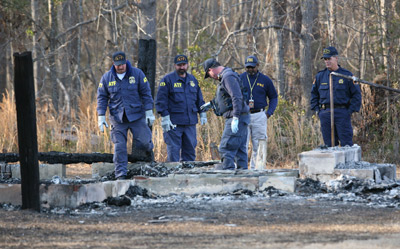
Samples are sealed in airtight containers and then tested for residues of accelerant liquid that might have been used to start the fire. These are the most common tests performed by forensics labs during an arson investigation:
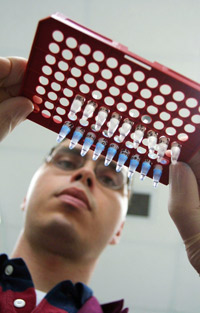
Murder scenes can produce a wealth of evidence, from shell casings to human blood and hair. Investigators gather all of this evidence, and forensic technicians analyze it in various ways, based on the type of evidence:
Gunshot residue: When a gun is fired, residue exits the gun behind the bullet. Traces of this residue can land on the hands of the person firing the weapon or on the victim. Police use tape or a swab to lift residue off the hands of a suspected shooter. Then the forensics technician uses a scanning electron microscope to examine the sample. Because elements in gunpowder have a unique X-ray signature, examination under the electron microscope can help determine whether the substance is actually gunshot residue. Technicians will also use dithiooxamide (DTO), sodium rhodizonate or the Greiss test to detect the presence of chemicals produced when a gun is fired.
Fibers: Infrared spectrometry/spectroscopy identifies substances by passing infrared radiation through them and then detecting how much of the radiation they absorb. It can identify the structure and chemical components of various substances like soil, paint or fibers. With this technique, forensic technicians can match fibers found on a victim's body to those in a piece of clothing or furniture.
Fingerprints: Fingerprinting relies on the unique pattern of loops, arches and whorls that covers each person's fingertips. There are two types of fingerprints. Visible prints are made on a card, or on a type of surface that creates an impression, such as blood or dirt. Latent prints are made when sweat, oil and other substances on the skin reproduce the fingerprints on a glass, murder weapon or any other surface the perpetrator has touched. These prints can't be seen with the naked eye, but they can be made visible using dark powder, lasers or other light sources.
One method forensics labs use to make latent prints visible uses cyanocrylate -- the same ingredient in superglue. When it's heated inside a fuming chamber, cyanocrylate releases a vapor that interacts with the amino acids in a latent fingerprint, creating a white print. Technicians may also use a wandlike tool that heats up a mixture of cyanocrylate and fluorescent pigment. The tool then releases gases on the latent prints, to fix and stain them on the paper. Other chemicals that react with oils in fingerprints to reveal latent prints include silver nitrate (the chemical in black-and-white film), iodine, ninhydrin and zinc chloride.
Body fluids: A number of tests are used to analyze blood, semen, saliva and other bodily fluids:
DNA analysis: DNA is the unique genetic fingerprint that distinguishes one person from another. No two people share the same DNA (with the exception of identical twins). Today, forensic scientists can identify a person from just a few tiny blood or tissue cells using a technique called polymerase chain reaction (PCR). This technique can make millions of copies of DNA from a tiny sample of genetic material.
To find out more about forensic labs and related topics, visit our links page. Related HowStuffWorks Articles
More Great Links
Sources