The term "DNA," once used only by scientists, has become an everyday part of our vocabulary. It's almost impossible to be unaware of the impact that the use of DNA has had on everything from the court system to genealogy. It's also nearly impossible to be unaware of the controversy. Now that, theoretically, we could each have a profile that can identify us solely by our DNA, many people are worried about how that profile might be used.
You probably have a good idea of what DNA is -- if not, read How DNA Works for the full story. However, what you may not know is exactly what type of information DNA evidence yields, how it's processed and how it's analyzed. That's where DNA profiling comes in.
Up Next
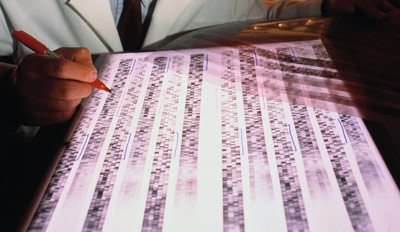
In any situation where DNA may be used, a DNA profile must be created. Also known as DNA or genetic typing, DNA profiling is simply the collection, processing and analysis of VNTRs -- unique sequences on the loci (area on a chromosome). VNTR stands for variable number tandem repeats -- meaning that the tandem repeats, or pairs of nucleotides, vary in number. Most DNA sequences in different people look too similar to tell apart. After processing, however, VNTRs result in bands that are unique enough to be used for identification. These differences were discovered in 1984 by Dr. Alec Jeffreys, while looking at results of an experiment, using DNA belonging to different family members of one of his lab technicians.
Until 1987 -- when the technique was commercialized -- Jeffreys' lab was the only one in the world doing DNA fingerprinting (the original name for DNA profiling, which was changed due to the confusion with actual fingerprinting).
Although this sounds simple enough, there are actually several different techniques for creating a DNA profile, and new technology is always emerging. We'll look at these techniques next.
ContentsIf they're all supposed to arrive at a similar result -- a unique DNA profile -- then why are there so many different techniques for analysis? Which technique to use depends on a couple of factors, including cost, time available for analysis and the quality and amount of the DNA sample available.
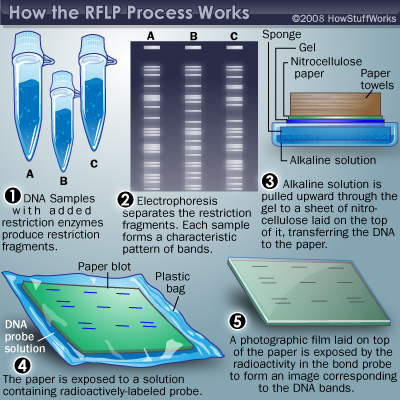
The first method for creating a DNA profile was RFLP, or restriction fragment length polymorphism. RFLP is not used as often today because it requires a large sample of DNA -- as much as 25 hairs or a nickel-sized spot of bodily fluid -- and can take as long as a month to complete [source: Baden]. It also requires examining multiple sections of the DNA strand to find variations, which is time-consuming and leaves more room for human error. Some of the steps for RFLP analysis are also used in other types of DNA profiling. For RFLP, the steps are:
PCR (polymerase chain reaction) analysis is usually the first step in the creation of a DNA profile today. PCR can replicate a small amount of DNA to create a larger sample for analysis. It does this using a repeating process that takes about five minutes. First, a heat-stable DNA polymerase -- a special enzyme that binds to the DNA and allows it to replicate -- is added. Next, the DNA sample is heated it to 200 degrees F (93 degrees C) to separate the threads. Then the sample is cooled and reheated. Reheating doubles the number of copies. After this process is repeated about 30 times, there is enough DNA for further analysis.
PCR is the first step in analyzing STRs (Short Tandem Repeats), which are very small, specific alleles in a variable number tandem repeat (VNTR). Alleles are pairs of genes that occur alternately at a specific point, or loci, on a chromosome. STRs are explained further in How DNA Evidence Works. Analyzing STRs is more accurate than the RFLP technique because their small size makes them easier to separate and to tell apart.
A variation on STR analysis is Y-STR. Only STRs found on the Y-chromosome (which only males have) is analyzed. STR analysis is useful if the sample has mixed DNA (from both men and women) or in sexual assault cases with a male assailant. Y-STR is otherwise processed just like a regular STR.
AmpFLP, amplified fragment length polymorphism, is another technique that uses PCR to replicate DNA. Like RFLP, it first uses a restriction enzyme. Then, the fragments are amplified using PCR and sorted using gel electrophoresis. AmpFLP's advantage over other techniques is that it can be automated and doesn't cost very much. However, the DNA sample must be high quality or errors may result, which is the case with most DNA analysis techniques. Analysts can have a time telling the longer strands apart because they bunch up tightly.
In this article, we'll look at how DNA profiles are used and why it's creating controversy.
DNA is often in the news, but one of the most recent stories included a new term: touch DNA. Although it's new to the media, touch DNA has been in existence for several years. DNA is usually recovered from bodily fluids such as blood and semen, which are often located by the stains they leave behind. Touch DNA involves recovering DNA from skin cells left by the perpetrator.
In the JonBenet Ramsey case, investigators scraped clothing that JonBenet had been wearing. There was enough evidence in two different places to create a DNA profile that matched one already created from blood -- both of which belong to a male not related to JonBenet. This convinced prosecutors that the Ramsey family could not have been responsible for JonBenet's death.
Once the profile is created, what's next? It really depends on how the DNA profile is to be used. If it was created from DNA recovered in a criminal investigation, prosecutors in the United States will enter it into CODIS, the Combined Data Index System. CODIS is a computer program maintained by the FBI, which operates databases across the country. These databases contain more than five million profiles. CODIS contains several different indexes:
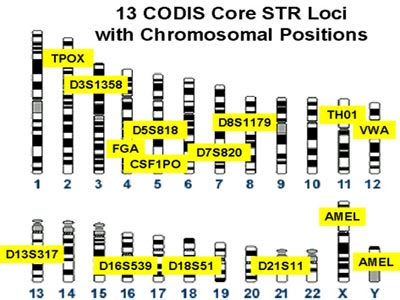
CODIS uses algorithms to compare 13 different STR locations, plus one that determines the gender of the person in question. It has rules and safeguards to protect the privacy of people whose profiles are in the database. The matching algorithms -- which must be confirmed by an analyst--can produce leads for law enforcement or even identify a potential assailant. The downside of using CODIS is that it's only as strong as the number of profiles included, and there is a backlog of more one million profiles to be entered.
Prosecutors can also use DNA experts to match profiles while building cases where there's a high degree of certainty of the assailant. However, DNA profiling is being used more and more for people convicted prior to its common use, which began in the late 1980s. Since the early 1990s, convicted criminals have been able to use the latest DNA profiling technology as part of their appeals process. Most states have laws explicitly describing the rights convicted criminals have to DNA testing. In some cases, people can request additional testing anytime, while in others, they must do so within a few years of their conviction.
Attention to post-conviction DNA testing really began with a 1996 National Institute of Justice report that spotlighted 28 people convicted of rape and murder who had been exonerated due to later DNA testing. Since 1989, more than 218 convicted criminals have been released after DNA testing proved their innocence. The true perpetrator was identified in 84 of those cases [source: The Innocence Project].

Aside from criminal trials and appeals, DNA profiling has become an important tool in genealogy. Many companies provide DNA profiling for this purpose. One of the largest ones, Family Tree DNA, uses Y-SRT testing to determine paternal lineage and mtDNA (mitochondrial DNA testing) to determine maternal lineage. When an embryo is conceived, its mitochondria -- structures within cells that convert energy from food -- come from the mother's egg cell, whereas the father's sperm contributes only nuclear DNA [source: Human Genome Project, U.S. National Library of Medicine]. For more information on mtDNA, see How DNA Evidence Works.
National DNA Database
The creation and storage of DNA profiles are also very controversial. As the databases searched by CODIS have expanded to include profiles of more than just convicted criminals, some people have begun to worry about what law enforcement, the government or even private companies may be able to do with the information. Once your profile is in a database, it can be removed only via court order. If you're using a private database for the purposes of genealogy, however, you can request the removal of your profile.
In April 2008, the Genetic Information Discrimination Act was signed into law. It's designed to keep insurance companies and employers from discriminating against people who may be genetically predisposed to a disease. To learn more about what expansions of DNA databases might mean for the future, see How Future Crime Databases Will Work.
The profiles vary in the amount of detail they can provide and in how far back in your ancestry they can determine a match. A Y-DNA67, for example, can show an extremely close connection between ancestors. It tests the Y chromosome for genetic matches between males. A perfect match of 67 markers on each person's DNA strand means they have a common ancestor in recent history [source: Family Tree DNA]. Family Tree DNA maintains databases of people looking for ancestors, and when a match is found, both parties are notified.
Although DNA profiling can reveal ancestry, companies that specialize in them don't perform any kind of testing specifically to trace hereditary defects or disease. However, genetic testing, which involves more than just DNA profiling, helps reveal hereditary predispositions to some diseases and birth defects. During genetic testing, DNA is profiled and analyzed along with RNA, proteins and other factors.
So DNA profiling can be very useful, but how accurate is it in determining a match? Family Tree DNA claims that it can determine within a "99.99 percent probability of yes or a 100 percent probability that no relationship existed" in the case of matching with an ancestor [source: Family Tree DNA]. That seems pretty irrefutable, but DNA profiling, especially in criminal cases, isn't infallible. In the next section, we'll look at some of the controversy associated with DNA profiling.
When DNA profiling was first used in criminal cases, it was often difficult for prosecutors and defense attorneys, as well as the experts they hired to testify, to explain the significance of their DNA match to the jury. Fingerprints are still considered by most people to be an ironclad way to identify someone, but an expert testifying about fingerprints discusses them in terms of "points of similarity." DNA matches are discussed in terms of statistical probability using what is currently known about DNA similarity within the general population. This often confused the jury or was interpreted incorrectly.
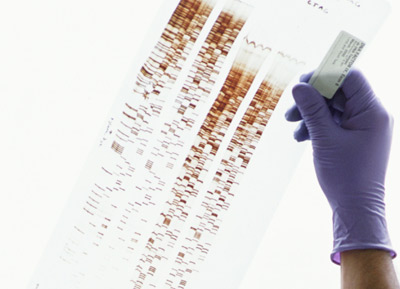
For example, an expert testifying about DNA profiling for the prosecution might say that the DNA profile created from the crime-scene evidence has a 4-to-5 probability (or 80 percent chance) of matching the DNA profile created from the defendant's sample. Saying that the probability of the match is 80 percent, however, is not the same thing as saying that the probability of the accused person's guilt is 80 percent.
On the other hand, an expert testifying about DNA profiling for the defense could say something like, "The likelihood that this person's DNA was found at the crime scene, but he did not commit the crime, is 1 in 10 (or 10 percent)." That isn't a very high probability, but it doesn't take into account the fact that the accused isn't just some random person plucked off the street. It's not likely that the DNA profile is the only reason why he or she was arrested for the crime. DNA is just one piece in a very large puzzle.
The DNA profiling and its interpretation have come under fire. RFLP analysis was in part discontinued because of the possibility for error. The risk of a coincidental match using RFLP is 1 in 100 billion. However, in laboratory settings, this risk is probably higher because technicians may misread similar patterns as identical or otherwise perform the analysis incorrectly. A 2002 study of accuracy of DNA laboratories in the United States conducted by the University of Texas showed that 1 in 100 profiles may give a false result.
STR analysis is not as subjective, but any DNA profile can give a false result if it is contaminated. Although there have been no documented cases of a laboratory worker intentionally contaminating a DNA sample, DNA samples have been contaminated or even faked by criminals in order to avoid prosecution. In 1992, Dr. John Schneeberger was accused of raping one of his patients while she was sedated. A DNA profile was created using the sample that he left on the victim. A profile from a sample of his blood did not match the crime-scene sample, and the case was closed. The victim persisted, and eventually Dr. Schneeberger was convicted after additional DNA samples showed a match. He was able to avoid the initial match by implanting a drain in his arm filled with another man's blood and an anticoagulant, and skillfully getting the technician who drew his blood to do so from that spot.
Ultimately, DNA profiling has proved to be an amazing tool. However, it's just one of the many tools used to find the truth in criminal investigations, genealogy searches and testing for disease. There is rarely a 100-percent certainty of anything.
For lots more information on DNA profiling and related topics, explore the links on the next page.Related HowStuffWorks Articles
More Great Links
Sources