Here's why:
* Colloids are heterogeneous mixtures: This means they have particles dispersed throughout a medium (like liquid or gas). These particles are larger than molecules but smaller than particles in a suspension.
* Light scattering: When a beam of light passes through a colloid, the light is scattered by the dispersed particles. This scattering makes the beam visible, appearing as a bright cone of light.
Key characteristics of the Tyndall effect:
* Visibility of the light beam: The scattered light makes the beam visible, which wouldn't be the case if the light passed through a true solution.
* Angle-dependent scattering: The intensity of scattered light depends on the angle at which it's observed.
* Particle size dependence: The Tyndall effect is more pronounced with larger particles in the colloid.
Examples of the Tyndall effect:
* Sunlight scattering through fog
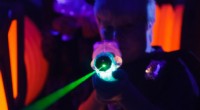
* A laser beam shining through milk
* Dust particles illuminated in a sunbeam
The Tyndall effect is a useful way to distinguish between colloids and true solutions. It's also used in various applications, like analyzing particle sizes in colloids and detecting the presence of impurities in solutions.