For every action, there is an equal and opposite reaction.
This means that whenever one object exerts a force on another object, the second object exerts an equal and opposite force on the first object. These forces are always the same strength but in opposite directions.
Here are some key points about Newton's third law:
* Forces always come in pairs: There is never a single force acting alone. If you push on a wall, the wall pushes back on you with the same force.
* The forces act on different objects: The action force acts on one object, while the reaction force acts on the other object.
* The forces are equal in magnitude and opposite in direction: This means that the forces have the same strength, but they act in opposite directions.
Examples of Newton's third law in action:
* Jumping: When you jump, your feet exert a downward force on the ground. The ground exerts an equal and opposite upward force on your feet, propelling you into the air.
* Swimming: When you swim, your arms and legs push against the water. The water pushes back with an equal and opposite force, propelling you forward.
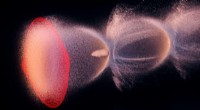
* Rocket propulsion: A rocket engine burns fuel and expels hot gas out of its nozzle. The hot gas pushes on the rocket, and the rocket pushes back on the gas with an equal and opposite force.
Understanding Newton's third law is essential for understanding many physical phenomena, such as how rockets work, how we walk, and how objects collide.