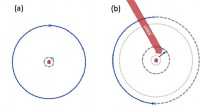
* Early Concepts: The idea of quantized energy levels in atoms was first proposed by Niels Bohr in 1913 with his model of the hydrogen atom. Bohr's model assigned specific energy levels to electrons orbiting the nucleus, but it didn't fully explain the structure of multi-electron atoms.
* Quantum Mechanics: The development of quantum mechanics in the 1920s, by physicists like Erwin Schrödinger and Werner Heisenberg, provided a more sophisticated and accurate understanding of atomic structure.
* The Principal Quantum Number: The principal quantum number (n) emerged from this theoretical framework. It represents the electron shell, with higher values indicating greater energy levels.
Therefore, while no single person "invented" the principal quantum number, its existence is rooted in the work of multiple pioneers in atomic physics, including:
* Niels Bohr: For his early model introducing quantized energy levels.
* Erwin Schrödinger and Werner Heisenberg: For their contributions to quantum mechanics, which provided the theoretical foundation for understanding atomic structure.
It's important to note that the concept of the principal quantum number continued to evolve and refine over time.