Gravity: The Driving Force
* Universal Gravitation: Every particle in the universe attracts every other particle with a force proportional to their masses and inversely proportional to the square of the distance between them. This force is what holds celestial bodies together.
* Even Distribution of Mass: When a large mass of gas and dust collapses under its own gravity, it tends to distribute its mass as evenly as possible. This is because gravity pulls equally from all directions.
How Gravity Shapes a Sphere
1. Initial Irregular Shape: The initial cloud of gas and dust forming a celestial body is likely to be irregular in shape.
2. Gravity's Pull: Gravity pulls matter towards the center of the cloud.
3. Equal Distribution: As matter falls towards the center, it encounters resistance from other particles, causing it to distribute itself more evenly. This even distribution leads to a more symmetrical shape.
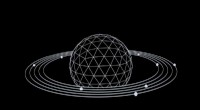
4. Sphere Formation: Eventually, the cloud of gas and dust becomes so dense that it forms a nearly perfect sphere. The sphere is the most stable shape for a body under its own gravity, minimizing its potential energy.
Centripetal and Centrifugal Forces Play a Role, but Indirectly
* Centripetal Force: This force pulls objects towards the center of a circular path. In the case of a celestial body, gravity acts as the centripetal force, keeping the matter from flying off into space.
* Centrifugal Force: This is an apparent force that pushes objects outward as they move in a circular path. While centrifugal force doesn't directly shape the celestial body, it does influence the distribution of matter. It acts against gravity, preventing the collapse of the body into a single point.
Important Note: While gravity is the primary force shaping celestial bodies, other factors can also influence their shape:
* Rotation: The rotation of a body creates an outward force that can slightly flatten it at the poles and bulge it at the equator.
* Internal Structure: The distribution of different materials within a celestial body can also affect its shape.
In conclusion: Gravity is the key force responsible for the spherical shape of celestial bodies. Centripetal and centrifugal forces play a supporting role, but their primary influence is in stabilizing the distribution of matter and preventing a complete collapse.