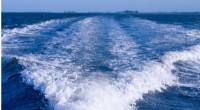
* Pressure Build-up: When a large wave crashes onto a rock, the water rushes into the cracks and crevices. This rapid influx of water compresses the air trapped inside the cracks. The trapped air, unable to escape quickly, becomes significantly pressurized.
* Force Amplification: This high pressure within the cracks exerts a powerful force on the surrounding rock. The pressure can be much greater than the force of the water itself, effectively acting as a wedge inside the rock.
* Crack Propagation: The force exerted by the compressed air can cause the cracks to widen and propagate further into the rock. Over time, with repeated wave impacts, these cracks can become large enough to cause the rock to break apart.
Evidence Supporting the Theory:
* Observations: Scientists have observed the phenomenon of wave-induced rock splitting firsthand. They have seen rocks break apart after being hit by large waves, often with pieces of rock flying away from the impact point.
* Experiments: Laboratory experiments have demonstrated that compressed air can indeed fracture rock. By simulating wave impacts in controlled settings, researchers have been able to observe the pressure build-up and resulting crack propagation.
* Rock Features: The characteristics of rock formations found near shorelines, such as the presence of numerous cracks and fragmented pieces, support the theory that wave action is a significant factor in rock erosion.
Other Factors:
While compressed air is a major contributing factor, other forces, such as the sheer force of the water, the abrasive action of sand and debris carried by the waves, and the impact of rocks against each other, also play a role in the erosion and splitting of rocks.
Conclusion:
The combination of pressure build-up from compressed air and the other forces involved in wave impacts provides a convincing explanation for the observed phenomenon of large crashing waves splitting apart rocks.