Here's why:
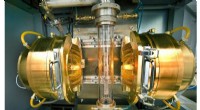
* Accelerating particles: Particle accelerators use electric and magnetic fields to accelerate charged particles, like protons or electrons, to extremely high speeds.
* Smashing particles: These high-energy particles are then directed to collide with targets, which can be other particles, atoms, or even heavier nuclei.
* Studying the debris: By analyzing the debris from these collisions, scientists can learn about the fundamental structure of matter, the forces that govern it, and the conditions that existed in the early universe.
Famous examples of particle accelerators:
* The Large Hadron Collider (LHC) at CERN: The world's largest and most powerful particle accelerator, used to discover the Higgs boson, among other discoveries.
* The Stanford Linear Accelerator Center (SLAC): Used for various research, including the discovery of the first particles containing charm quarks.
So, the next time you hear about smashing atoms, think of particle accelerators – they're the tools that let scientists delve into the very fabric of our universe!