Here's why planets don't fly off in a straight line and instead orbit the sun:
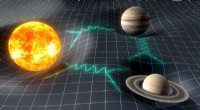
* Gravity: The sun's immense gravity pulls on the planets, constantly changing their direction. This pull is an unbalanced force, constantly acting on the planets.
* Orbital Velocity: Planets are moving incredibly fast, with a velocity that's just right to balance the sun's gravitational pull. Imagine a ball tied to a string, being swung in a circle. The string provides the inward force (like gravity), while the ball's speed (velocity) prevents it from flying off in a straight line.
In essence, the planets are constantly falling towards the sun due to its gravity, but their forward motion keeps them from actually hitting the sun. This continuous falling and missing is what creates the elliptical orbits we observe.