1. Special Theory of Relativity:
- The special theory of relativity focuses on the relationship between space and time in the absence of gravitational forces.
- It postulates that the speed of light in a vacuum is the same for all observers, regardless of their motion or the motion of the light source.
- Time dilation: Moving clocks run slower compared to stationary clocks.
- Length contraction: Objects in motion appear shorter than when they are at rest.
- Mass-energy equivalence: Energy and mass are equivalent, as described by the famous equation E=mc², where E represents energy, m represents mass, and c is the speed of light.
2. General Theory of Relativity:
- The general theory of relativity extends the special theory to include the effects of gravity.
- It suggests that gravity is not a force but rather a curvature of spacetime caused by the presence of mass and energy.
- Gravitational time dilation: Time runs slower in stronger gravitational fields. For instance, time passes more slowly on Earth's surface compared to in outer space.
- Gravitational lensing: Light from distant stars bends when passing through the gravitational field of massive objects, resulting in distortions and magnifications.
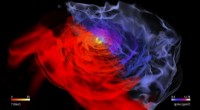
- Black holes: Extremely massive objects can create regions of spacetime with such strong gravitational forces that nothing, not even light, can escape. These regions are known as black holes.
The theory of relativity has had a profound impact on our understanding of the universe and has led to advancements in various fields, including astronomy, cosmology, and GPS technology. It has also challenged our classical notions of space and time, redefining our perspective on the fundamental fabric of the cosmos.