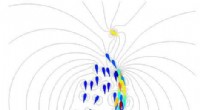
1. Magnetic Field Interaction: The bar magnet creates a magnetic field around it, and the U-will experiences this magnetic field. The U-will also has its own magnetic field due to the presence of unpaired electrons in the iron atoms.
2. Attraction or Repulsion: Depending on the orientation of the bar magnet and the U-will, they can experience either attraction or repulsion. If the north pole of the bar magnet is facing the south pole of the U-will, they will attract each other. Conversely, if the south pole of the bar magnet is facing the south pole of the U-will, they will repel each other.
3. Magnetic Force: The strength of the attraction or repulsion between the bar magnet and the U-will depends on several factors, including the strength of the magnetic fields, the distance between them, and the materials involved. The magnetic force between two magnetic objects follows an inverse square law, meaning the force decreases as the square of the distance increases.
4. Magnetic Alignment: When the bar magnet is near the U-will, it exerts a magnetic force on the magnetic domains within the U-will. These domains tend to align with the external magnetic field created by the bar magnet. As a result, the magnetic moments of the individual atoms in the U-will become aligned, making it behave like a temporary magnet.
5. Magnetic Induction: The process of magnetic alignment induced by the bar magnet in the U-will is known as magnetic induction. The magnetic field of the bar magnet induces a magnetic field in the U-will, which causes the U-will to become magnetized.
6. Magnetic Hysteresis: After the bar magnet is removed, the U-will may retain some of its induced magnetism, depending on the material properties. This phenomenon is called magnetic hysteresis. The extent of hysteresis depends on the material's coercivity, which is its resistance to demagnetization.
In summary, as the bar magnet nears the U-will, it interacts with the U-will's magnetic field, causing attraction or repulsion. The magnetic force between them depends on the strength of the magnetic fields and the distance. The bar magnet induces magnetic alignment in the U-will through magnetic induction, and the U-will may retain some of its induced magnetism after the bar magnet is removed due to magnetic hysteresis.