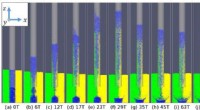
1. Wind Acceleration:
- As wind approaches a steep slope, it starts to accelerate due to the reduction in surface friction. The air flowing over the slope is less obstructed, leading to increased wind speed. This acceleration is more pronounced for steeper slopes and stronger winds.
2. Upward Deflection:
- As the wind continues up the slope, it is deflected upward due to the topography. This upward deflection creates an upslope flow, where the wind direction changes from horizontal to an upward angle. The stronger the upward deflection, the more the wind will deviate from its original direction.
3. Formation of Standing Waves:
- When the wind interacts with a steep slope, it can create standing waves or mountain waves. These waves resemble stationary undulations in the airflow and result from the interaction between the wind and the topography. Standing waves can cause further variations in wind speed and direction as the wind moves up and down the slope.
4. Turbulence and Eddies:
- The uneven terrain of steep slopes introduces additional turbulence and eddies into the airflow. As the wind flows over theslope, it encounters irregularities, obstacles, and changes in surface roughness, which can disrupt the smooth flow of the air and create turbulent conditions.
5. Downward Flow:
- On the leeward side of the slope, the wind experiences a downward deflection after reaching its peak elevation. This creates a downslope flow, where the wind direction changes from an upward angle to a downward angle. The downward flow can result in localized wind accelerations and increased turbulence
6. Effects of Atmospheric Stability:
- Atmospheric stability plays a role in determining how wind behaves when it meets a steep slope. In stable atmospheric conditions, where the air is more resistant to vertical movement, the upward deflection of the wind is less pronounced, and standing waves are less likely to form. In unstable conditions, characterized by convective activity, the upward deflection and wave formation are more significant.
In summary, when wind encounters a steep slope, it undergoes several changes, including acceleration, upward deflection, the formation of standing waves, turbulence, and downward flow. Understanding these changes is crucial for various applications, such as wind energy siting, aviation safety, and mountain meteorology.