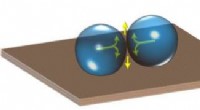
When water flows out of the sprinkler holes, the water exerts a force on the holes. This force creates a torque, which causes the sprinkler to spin. The spin of the sprinkler conserves angular momentum, which means that the total angular momentum of the water before it leaves the holes is equal to the total angular momentum of the sprinkler after the water has left the holes.
Mathematically, the conservation of angular momentum can be expressed as:
```
Iω1 = Iω2
```
where:
* I is the moment of inertia of the sprinkler
* ω1 is the initial angular velocity of the water before it leaves the holes
* ω2 is the final angular velocity of the sprinkler after the water has left the holes
The moment of inertia of a rotating object is a measure of how difficult it is to change its angular velocity. The greater the moment of inertia, the more difficult it is to change the angular velocity.
In the case of a sprinkler, the moment of inertia is determined by the mass and distribution of mass of the sprinkler. The heavier the sprinkler, and the further the mass is distributed from the center of rotation, the greater the moment of inertia will be.
The initial angular velocity of the water before it leaves the holes is determined by the pressure of the water flowing through the sprinkler. The greater the pressure, the higher the initial angular velocity will be.
The final angular velocity of the sprinkler after the water has left the holes is determined by the conservation of angular momentum. The greater the initial angular velocity of the water, and the greater the moment of inertia of the sprinkler, the lower the final angular velocity of the sprinkler will be.
In summary, the physics principle that explains why a water sprinkler spins is the conservation of angular momentum. The water flowing out of the holes creates a torque, which causes the sprinkler to spin. The spin of the sprinkler conserves angular momentum, which means that the total angular momentum of the water before it leaves the holes is equal to the total angular momentum of the sprinkler after the water has left the holes.