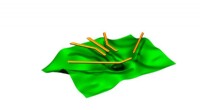
* Gravitational force: This is the force of attraction between two objects with mass. The greater the mass of the objects, the greater the gravitational force between them. Gravitational force is what keeps us on the ground and also what causes objects to fall.
* Electromagnetic force: This is the force between charged particles. Charged particles can be positive or negative, and the force between them depends on their charges. The electromagnetic force is what holds atoms together, and it is also what causes many chemical reactions.
* Strong nuclear force: This is the force that holds the protons and neutrons together in an atom's nucleus. The strong nuclear force is the strongest of the four fundamental forces, but it only acts over very short distances.
* Weak nuclear force: This is the force that is responsible for certain types of radioactive decay. The weak nuclear force is the weakest of the four fundamental forces, and it only acts over very short distances.
* Friction: This is the force that opposes the motion of an object as it moves against a surface. Friction is caused by the interaction of the atoms on the surface of the object with the atoms on the surface it is moving against.
* Air resistance: This is the force that opposes the motion of an object as it moves through the air. Air resistance is caused by the collision of the object with the molecules in the air.
* Buoyant force: This is the force that opposes the weight of an object when it is immersed in a fluid. Buoyant force is caused by the upward pressure of the fluid on the object.
* Centripetal force: This is the force that keeps an object moving in a circular path. Centripetal force is directed towards the center of the circle and is equal to the mass of the object times the square of its velocity divided by the radius of the circle.
These are just some of the many forces that can affect the motion of an object. The sum of all the forces acting on an object at any given moment determines its acceleration.