1. Redistribution of Charges:
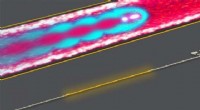
The presence of the charged object creates an electric field in the surrounding area. This electric field exerts a force on the mobile charges (usually electrons) within the metallic object. As a result, the electrons in the metallic object start to move and redistribute themselves. This process is known as charge induction or electrostatic induction.
2. Induced Charges:
The redistribution of charges within the metallic object results in the accumulation of charges on its surface. The surface closest to the charged object acquires an opposite charge to that of the charged object, while the opposite surface acquires a charge of the same sign as the charged object. These induced charges create an electric field that opposes the electric field of the charged object, reducing its overall effect on the metallic object.
3. Polarization:
The induced charges on the metallic object create an internal electric field that aligns the dipoles (pairs of opposite charges) within the metal. This alignment of dipoles is known as polarization. The polarization of the metallic object further reduces the electric field of the charged object inside the metal.
4. Shielding Effect:
The induced charges on the surface of the metallic object create an electric field that cancels out the electric field of the charged object inside the metal. This phenomenon is known as the shielding effect. As a result, the electric field inside the metallic object is significantly reduced, and the metallic object acts as a shield against the electric field of the charged object.
In summary, when a charged object is brought near a metallic object that is not charged, the metallic object undergoes charge redistribution, resulting in induced charges on its surface. These induced charges create an opposing electric field that reduces the effect of the charged object's electric field inside the metal. This phenomenon is known as the shielding effect and ensures that the electric field inside the metallic object remains relatively weak.