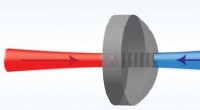
1. Reflection: The majority of the light rays that strike the mirror's surface are reflected. This means that they bounce off the mirror and travel in a different direction. The angle at which the light rays are reflected is equal to the angle at which they hit the mirror. This behavior is governed by the law of reflection: "The angle of incidence equals the angle of reflection."
2. Image Formation: Mirrors can create virtual images of objects placed in front of them. When light rays from an object strike the mirror and are reflected, they appear to come from a point behind the mirror. This point is where the image of the object is formed. Depending on the type of mirror (flat, concave, or convex), the image characteristics (size, shape, orientation, and distance from the mirror) can vary.
3. Diffuse Reflection (for Non-Perfect Mirrors): In real-world scenarios, mirrors are not perfectly smooth at the microscopic level, resulting in a phenomenon called diffuse reflection. This means that some of the incident light rays are scattered in various directions instead of being reflected in a well-defined direction. This scattering of light contributes to the appearance of a rough or non-uniform surface.
4. Absorption: A portion of the incident light may also be absorbed by the mirror's surface. This absorption depends on the material properties of the mirror. The absorbed light is converted into other forms of energy, such as heat.
The specific behavior of light when it hits a mirror depends on several factors, including the type of mirror (e.g., flat, concave, or convex), the surface properties (smoothness, reflectivity, and absorption), and the characteristics of the incident light (wavelength, angle of incidence, and intensity).