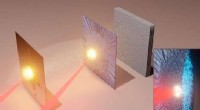
1. Reflection: The primary interaction between the light ray and the mirror is reflection. The mirror's surface acts as a smooth and reflective boundary, causing the light ray to bounce off in a predictable manner. The incoming ray of light, known as the incident ray, strikes the mirror's surface at a specific angle called the angle of incidence. According to the law of reflection, the reflected ray (the light ray bouncing off the mirror) makes the same angle with the surface normal (a line perpendicular to the mirror's surface) as the incident ray. This means the angle of reflection is equal to the angle of incidence.
2. Image Formation: Mirrors can form images of objects placed in front of them. For flat mirrors, such as plane mirrors, the image formed is a virtual image. A virtual image appears to be located behind the mirror's surface and cannot be projected onto a screen. The image in a flat mirror is laterally inverted, meaning left and right are reversed.
3. Types of Mirrors: There are different types of mirrors, including plane mirrors, concave mirrors, and convex mirrors. Each type of mirror has unique properties and produces different effects on light rays.
- Plane mirrors: As mentioned earlier, plane mirrors create virtual, upright, and laterally inverted images.
- Concave mirrors: Concave mirrors have a curved reflecting surface that curves inward. They converge (focus) incoming light rays at a single point called the focal point. Concave mirrors can produce both real and virtual images, depending on the object's position relative to the mirror and the focal point.
- Convex mirrors: Convex mirrors have a curved reflecting surface that curves outward. They diverge (spread out) incoming light rays. Convex mirrors always produce virtual, upright, and reduced-size images of objects.
In summary, when a ray of light hits a mirror, it undergoes reflection, and the reflected ray follows specific rules based on the type of mirror and the angle of incidence. Mirrors can form images, and the nature of these images depends on the mirror's shape and the object's position.