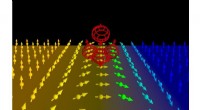
The total charge of a closed system remains constant, no matter what changes occur within the system itself.
In equation form, this law can be expressed as:
$$\sum_{i=1}^{n}Q_i = constant$$
where:
* \(Q_i\) is the charge of the \(i^{th}\) particle in the system
* \(n\) is the total number of particles in the system
This law has important implications in many areas of physics, including electromagnetism, chemistry, and nuclear physics. For example, it tells us that when two oppositely charged particles collide, they cannot simply annihilate each other and disappear. Instead, the total charge of the system must remain constant, so the charges of the particles must be transferred to other objects in the system.
Another important consequence of the conservation of charge law is that the total amount of positive and negative charge in the universe must always be the same. This means that it is impossible to create or destroy charge.