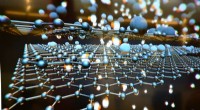
Vibrations, on the other hand, refer to the oscillatory motion of particles or objects, either in a mechanical context or in the context of quantum mechanical phenomena. Vibrations can occur due to various forces or interactions, resulting in the oscillation of particles around a central point or position.
The relationship between electromagnetic waves and vibrations is evident when considering the emission, propagation, and interaction of electromagnetic waves. Here are key aspects that illustrate this relationship:
1. Emission: Electromagnetic waves are emitted by vibrating charged particles, such as electrons in atoms or molecules. When these charged particles undergo acceleration, they generate oscillating electric and magnetic fields, giving rise to electromagnetic waves. The frequency of the electromagnetic waves corresponds to the frequency of vibration of the charged particles.
2. Propagation: Electromagnetic waves propagate through space as a result of the continuous oscillation and interaction of electric and magnetic fields. These fields create alternating currents and voltages in the material medium, which leads to the propagation of the wave. In a vacuum, electromagnetic waves travel at the constant speed of light (approximately 299,792,458 meters per second).
3. Resonance: Electromagnetic waves can interact with matter in a resonant manner. When the frequency of the electromagnetic waves matches the natural frequency of vibration of a material, it can cause the material to vibrate in sympathy. This phenomenon is known as resonance, which plays a crucial role in various phenomena such as tuning radio stations and acoustic resonance in musical instruments.
4. Quantum Mechanical Vibrations: In quantum mechanics, particles such as electrons and photons exhibit wave-particle duality, meaning they have characteristics of both particles and waves. The wave nature of particles is associated with vibrations or oscillations, where the wave function of a particle describes its state and probability of being found in a given region.
5. Wave-Particle Duality: The particle-like behavior of electromagnetic waves is also evident in certain phenomena, such as the photoelectric effect. When light interacts with a metal surface, it can cause the emission of electrons (photoelectrons). This effect can be explained by considering light as a stream of particles or photons, each carrying a discrete amount of energy or quanta, known as photons.
In summary, electromagnetic waves are intimately connected to vibrations, both at the macroscopic and quantum levels. The emission, propagation, and interaction of electromagnetic waves are closely related to the oscillatory motion of charged particles and the resonant behavior of matter. Understanding this relationship is fundamental in various scientific fields, including electromagnetism, optics, quantum mechanics, and more.