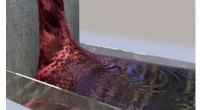
Sedimentation occurs when the density of the particles in a solution is higher than the density of the liquid, causing them to sink under the force of gravity. The rate of sedimentation is influenced by several factors, including the size and density of the particles, the viscosity of the liquid, and the temperature of the solution.
In general, larger and denser particles sediment faster than smaller and less dense particles. This is because larger particles have a greater gravitational force acting on them, and they experience less resistance from the liquid due to their larger size. The viscosity of the liquid also affects the rate of sedimentation, with higher viscosity liquids causing particles to settle more slowly. Temperature can also influence sedimentation, as higher temperatures generally reduce the viscosity of liquids, allowing particles to move more freely and sediment faster.
Therefore, while gravity does not directly cause a solution to separate, it does play a role in the rate of sedimentation, which can lead to the separation of particles in a solution over time.