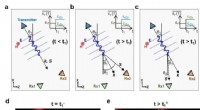
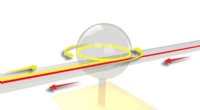
Here's how laser beams can carry signals:
1. Modulation: Similar to radio waves, laser beams can be modulated to carry information. This is done by varying the intensity, frequency, or phase of the laser light. The variations in the laser beam correspond to the information that is being transmitted.
2. Line-of-Sight Transmission: Laser beams, like radio waves, propagate through the atmosphere. However, unlike radio waves, which can diffract around obstacles, laser beams travel in a straight line. This means that laser communication requires a clear line of sight between the transmitter and receiver.
3. High Bandwidth: Laser beams have a much higher frequency than radio waves, which allows them to carry significantly more information. This makes them suitable for transmitting large amounts of data at very high speeds.
4. Low Interference: Laser communication systems experience less interference compared to radio waves. This is because laser beams are highly directional and can be precisely focused, reducing the chances of interference from other sources.
5. Security: Laser communication systems offer a higher level of security compared to radio waves. Since laser beams are highly directional, it is more challenging for unauthorized individuals to intercept the signals.
6. Long-Distance Communication: Laser communication can be used for long-distance communication, including satellite communications and deep space communications. This is because laser beams can travel through space with minimal loss, making them ideal for establishing communication links over vast distances.
Overall, laser beams provide several advantages over radio waves for carrying signals, such as higher bandwidth, lower interference, improved security, and the ability to transmit over long distances.