Motion of Particles:
- In a liquid state, particles have relatively high kinetic energy and move freely, colliding with each other and the container walls. Their motion is random and chaotic.
- As the substance cools and approaches its freezing point, the kinetic energy of the particles decreases, causing them to move more slowly. The collisions between particles become less frequent and less energetic.
Arrangement of Particles:
- In a liquid state, particles are relatively far apart and have no fixed positions. They can move past each other easily due to the high kinetic energy.
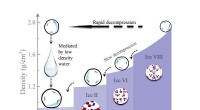
- As the substance freezes, the particles lose more kinetic energy and come closer together. They start to arrange themselves in a more ordered and fixed pattern, forming a crystalline structure. The arrangement of particles becomes more rigid and compact.
- The specific arrangement of particles in a solid depends on the substance's crystal structure. Each substance has a unique crystal structure that determines how its particles are arranged in a solid state.
In summary, during freezing, the motion of particles slows down, and their arrangement becomes more organized and fixed, resulting in the formation of a solid with a crystalline structure. This change in particle motion and arrangement is what gives solids their characteristic properties, such as rigidity, definite shape, and higher density compared to liquids.