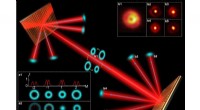
Single slits or multiple slits with accurately defined dimensions are used in typical diffraction experiments to create coherent interference patterns. These experiments often use lasers, which emit monochromatic and coherent light, in combination with precisely manufactured slits or gratings. The distance between the slits, the wavelength of light, and the distance to the observation screen are all factors that affect the resulting pattern.
While it's possible to observe diffraction patterns with a flashlight, it requires a specific setup. You can create a simple diffraction experiment by shining a flashlight through a small hole in a piece of paper onto a distant wall or projection surface. The hole acts as a single slit, and you might notice a faint pattern of alternating bright and dark fringes on the wall. However, the quality and visibility of the pattern will likely be limited compared to a controlled experiment with a laser.