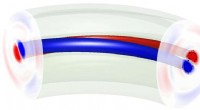
S-waves can only travel through solids in which particles are held relatively rigidly in place and thus can oscillate around equilibrium positions.
Therefore, S-waves cannot pass through liquids and gases, where particle positions are subject to change through free or loosely bound movement. Examples of solids that allow the passage of S-waves include rocks, metal, wood, and glass.