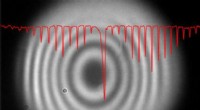
For a single slit, the diffraction pattern is given by the following equation:
$$I = I_0\frac{\sin^2(\beta)}{\beta^2}$$
where:
* \(I\) is the intensity of light at a given angle \(\theta\)
* \(I_0\) is the intensity of light at the centre of the pattern
* \(\beta = \frac{\pi w}{\lambda}sin\theta\)
* \(w\) is the width of the slit
* \(\lambda\) is the wavelength of light
The equation shows that the intensity of light at a given angle decreases as the width of the slit decreases. This means that diffraction is less pronounced when the slit width is small.
When the slit width is less than the wavelength of light, the diffraction pattern becomes very narrow. This is because the light waves are not able to spread out very much around the edges of the slit. As a result, the diffraction pattern is not visible.
Diffraction is an important phenomenon in optics. It is used in a variety of applications, such as telescopes, microscopes, and spectrometers.