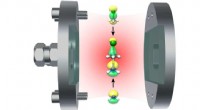
Magnetic materials are composed of tiny magnetic domains, which are regions where the magnetic moments of individual atoms are aligned. In a magnetized material, these domains are aligned in the same direction, creating a net magnetic field. Heating the material causes the thermal energy to overcome the magnetic interactions between the domains, allowing them to become misaligned and cancel out each other's magnetic fields. As a result, the overall magnetization of the material decreases with increasing temperature.
The temperature at which a material loses its ferromagnetism is called the Curie temperature. Below the Curie temperature, the material is ferromagnetic and exhibits permanent magnetism. Above the Curie temperature, the material becomes paramagnetic, meaning that it can be magnetized by an external magnetic field but does not retain any permanent magnetism.
In addition to magnetic materials, heating can also demagnetize objects made of ferromagnetic materials, such as iron, nickel, and cobalt. These materials exhibit ferromagnetism at room temperature but can be demagnetized by heating them above their Curie temperatures.