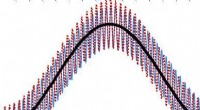
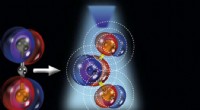
1. Sound Source: When an object vibrates, it creates sound waves. For example, when you pluck a guitar string, it vibrates and creates sound.
2. Compression and Rarefaction: As the vibrating object moves back and forth, it compresses and rarefies (expands) the air molecules in the surrounding medium. Compression refers to the crowding together of molecules, while rarefaction refers to the spreading apart of molecules.
3. Sound Wave: These alternating regions of compression and rarefaction form a sound wave. The sound wave consists of a series of high-pressure (compression) and low-pressure (rarefaction) zones.
4. Propagation: The sound wave propagates through the medium as the vibrations transfer energy from one particle to another. Each particle in the medium vibrates back and forth, causing neighboring particles to do the same.
5. Transfer of Energy: The vibrations of particles carry the energy of the sound wave. The energy is transferred through collisions or interactions between neighboring molecules.
6. Speed of Sound: The speed at which sound travels depends on the medium through which it is traveling. In general, sound travels faster in denser media. For example, sound travels faster in water (1,482 m/s) than in air (343 m/s) at room temperature.
7. Wave Properties: Sound waves exhibit typical wave properties such as wavelength, frequency, and amplitude. The wavelength is the distance between two consecutive compression peaks, the frequency is the number of vibrations per second, and the amplitude is the maximum displacement of particles from their rest positions.
8. Hearing: When sound waves reach our ears, the vibrations cause the eardrums to vibrate. These vibrations are transmitted to the inner ear, where they are converted into electrical signals that the brain interprets as sound.
9. Reflection, Refraction, and Absorption: Sound waves can reflect off surfaces, just like light waves. They can also refract (bend) when passing from one medium to another. Additionally, some materials can absorb sound energy, reducing the intensity of the sound waves.
10. Reverberation and Echo: When sound waves reflect off surfaces and bounce around in a space, it can create reverberation or echoes. Reverberation is the persistence of sound after the source has stopped producing it, while an echo is a delayed repetition of a sound due to reflection from a distant surface.
Understanding how sound travels through vibrations is crucial for various fields, including acoustics, music, audio engineering, and telecommunications. It allows us to design and optimize systems related to sound production, recording, transmission, and noise control.