1. The Positive Nucleus: Rutherford's experiment demonstrated the existence of a tiny, dense positive nucleus at the center of the atom. Most of the atom's mass is concentrated within the nucleus.
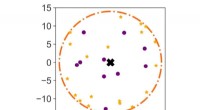
2. Deflection of Alpha Particles: Rutherford's experiment showed that the deflection and scattering of alpha particles fired at a gold foil were evidence of a positive charge concentrated in a very small volume within the atom. This contradicted the prevailing Thomson model of a uniform distribution of positive and negative charges.
3. Rutherford Scattering Formula: The results of the experiment allowed Rutherford to develop a mathematical equation, known as the Rutherford scattering formula, to describe the scattering pattern of alpha particles by atomic nuclei. This formula enabled the estimation of the size of the nucleus and provided quantitative insights into the structure of the atom.
These findings revolutionized the understanding of atomic structure and led to the development of the Rutherford model of the atom, which is a stepping stone to our current understanding of the atomic structure based on quantum mechanics.