Magnetic confinement—A tokamak reactor utilizes a combination of toroidal (donut-shaped) and poloidal (vertical) magnetic fields to confine the plasma. The toroidal magnetic field is generated by external coils surrounding the vacuum vessel. The poloidal field is generated by a current of charged particles flowing within the plasma itself, or by a set of internal coils. The net effect is the formation of helical magnetic field lines that serve as invisible magnetic bottles, trapping the charged particles within the plasma and preventing them from touching the vessel walls and losing their energy.
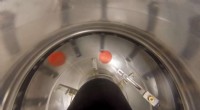
Vacuum vessel shape—The tokamak's vacuum vessel is typically shaped like a toroidal donut with a circular or non-circular cross-section. This specific design helps enhance plasma stability. Non-circular cross-section shapes, such as the elongated "D-shape" or the double-humped "peanut-shape," are commonly employed to optimize the confinement properties and mitigate certain instabilities.
When the magnetic fields and the vacuum vessel shape are carefully engineered and balanced, the plasma is effectively confined, allowing for the fusion reactions to take place.