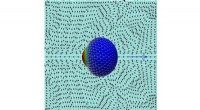
As a result, the particles start to organize themselves into more fixed and regular patterns, forming crystalline structures. The formation of these crystals marks the transition from the liquid phase to the solid phase, or in other words, the liquid freezes and turns into a solid.
This process of crystallization typically occurs throughout the liquid when the temperature reaches the freezing point, causing the entire liquid to solidify. However, in some cases, the freezing process can begin at specific nucleation points, such as impurities or container surfaces, and then spread throughout the liquid as more particles attach to the growing crystals.
The specific arrangement of particles in the crystalline structure depends on the substance and its molecular properties. Different substances may exhibit different crystal structures, leading to the formation of distinct solid phases with varying physical properties.